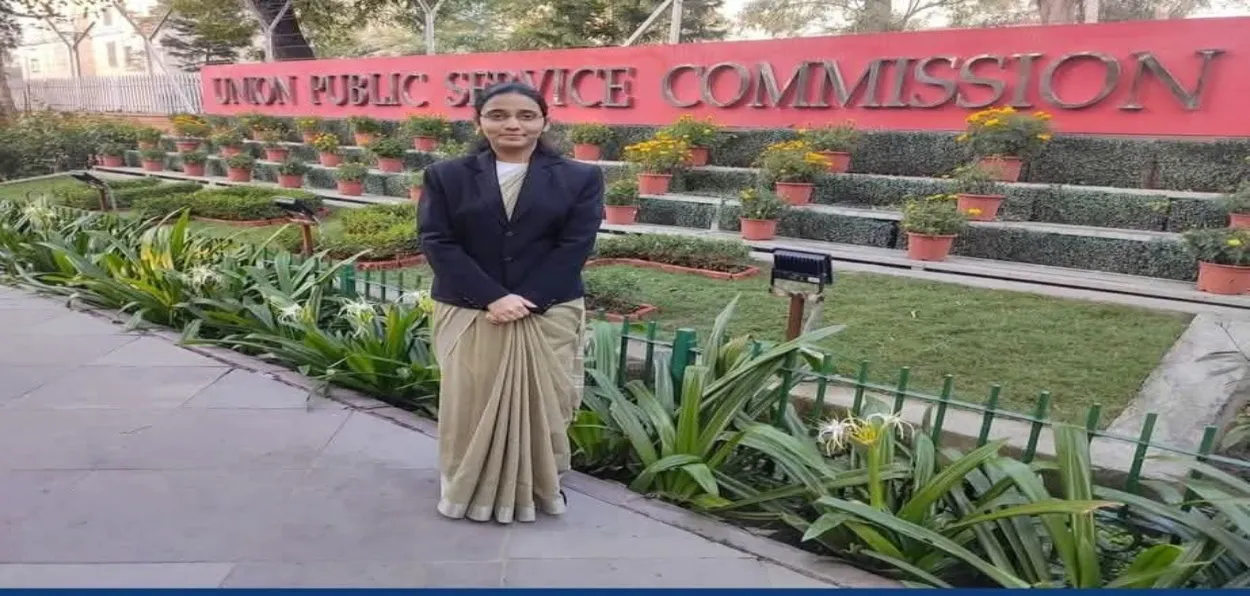
Farkhanda Qureshi of Balaghat, Madya Pradesh, outside UPSC office in Delhi
Farkhanda Qureshi was in her eighth grade when she saw district Collector B. Chandrasekharan son a local Television channel. This visual ignited a dream in her mind; she too wanted to become a civil servant. Today this Muslim woman from from Balaghat, a small town of Madhya Pradesh, has realized her dream which she nurtured over the years with passion, hard work, overcoming failures and perseverance.
Farkhanda Qureshi has secured 67th rank in the UPSC 2024 Civil Services Examination and would soon join the Lal Bahadur Shashtri National Academy for Administration, Dehradun, for training to become an Indian civil servant.
“I had decided that one day I will also become a collector and work for society.” She credits her success in her fourth attempt to her family’s support.
She started preparing for UPSC in 2021. Despite failures, she did not give up. She says, “My parents did not let me break down; they motivated me and told me that I will get success one day. Had they not supported me, I would have probably given up in the first or second attempt,” she told the told media persons.
Farkhanda believes that for a tough exam like UPSC, studying for 18 hours is not necessary, but consistency and strategy are. “I studied for 6 to 8 hours every day, but I studied every day. Old year papers, standard books, current affairs and newspapers were an important part of my preparation.”
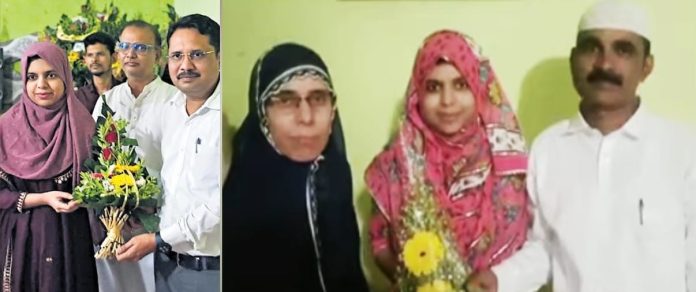
Farkhanda Qureshi flanked by her parents Nikhat Anjum and Abdul Malik Qureshi
Farkhanda, who completed her 10th from St. Mary’s School and 12th from Methodist Mission, says, “Being from a small town like Balaghat has never been my weakness. I believe that if the youth here get the right direction and resources, they can make a name for themselves across the country.”
Farkhanda considers her father Abdul Malik Qureshi, who is a lawyer, and her mother Nikhat Anjum Qureshi, a homemaker, her heroes and credits her success to them.
Her father said, “Today people recognize me by my daughter’s name, nothing can give me greater happiness than this.”
There is a festive atmosphere in the area, the collector congratulated Farkhanda and and wished her a bright future. The local mosque committee (Anjuman( also felicitated her and called her inspiration for the Muslim youth.
Out of the 1,009 candidates recommended by UPSC this year, 26 are Muslims, though none made it to the Top 25.
Iram Choudhary (Rank 40) and Farkhanda Qureshi (Rank 67) are the highest-ranking Muslim candidates in the merit list. A total of 97 Muslim candidates were selected for the interview stage, and the success rate stands at 2.57%, lower than previous years.
source: http://www.awazthevoice.in / Awaz, The Voice / Home> Stories / by Abdul Wasim Ansari, Balaghat, Bhopal (name error edited) / April 26th, 2025
Do it again and again. Consistency makes the raindrops create holes in the rock. Whatever is difficult can be done easily with regular attendance, attention, and action. Perhaps imbibed by the words of Israelmore Ayivor, an inspirational writer, blogger and LifeSkills Entrepreneur, Adeeba Anam Ashfaque Ahmed from Yavatmal in Maharashtra created a record of sorts to become the first female Muslim IAS officer after successfully clearing the civil services with All India Rank 142.
The success saga of Adeeba only proves the awareness shown by Muslim girls to take up civil services exams breaking the barriers.
On cloud nine are Adeeba’s parents, relatives, friends and more particularly her teachers on seeing her victory after three failures. She came out with flying colours in her fourth attempt after getting the necessary guidance and coaching from Jamia Millia Residential Coaching Academy in Delhi.
Can’t imagine a girl hailing from a parched and drought-prone Yavatmal district bringing glory to her native. All because of her patience and consistency as to the quote of American business honcho Robert Kiyosaki – “Successful people don’t fear failure but understand that it’s necessary to learn and grow from.” It is learnt that Maharashtra hardly witnessed any female Muslim IAS officers in the last one decade or so.
Kudos to her dad Ashfaq Ahmed, an auto driver, who despite financial constraints strained his nerves to make his daughter’s civil service dream a reality. Of course, her mom and uncle were very supportive in ensuring she achieved her IAS after successive failures. Adeeba started her early education at Zafarnagar Zilla Parishad Urdu Primary School, where she studied from Class 1 to Class 7. Thereafter, she finished schooling from Class 8 to 10 at Zilla Parishad Government Girls High School. And she completed her 11th and 12th grades at Zilla Parishad Ex-Government College in Yavatmal.
Armed with BSc Mathematics from Inamdar Senior College in Pune, she joined a coaching academy in Pune to take UPSC foundation classes based on the advice of her maternal uncle Jan Nizamuddin Sahib, who works as secretary at Seva NGO.
She got interested after meeting a few IAS officers and was determined to become an IAS. The road to civil services wasn’t smooth for her as she faced many obstacles. However, she was firm and worked relentlessly to taste success.
Noteworthy to mention that her dad Ashfaq Ahmed dropped out of school after tenth standard due to family circumstances. But decided not to let her daughter face the same fate, left no stone unturned and encouraged Adeeba to do her UG. Right from her school days, she had a fascination for civil services inspired by the young IAS officers’ remarkable feat through newspapers. Since then, she has been working towards her civil service dream.
In an interview to a local television channel, she is reported to have said that studying isn’t easy, especially for girls in patriarchal communities like Muslim, but her parents stood by her. She expressed her gratitude to mom, who extended support for her in her endeavours. The community was against girls pursuing higher studies, but her dad told her not to worry about society, and focus on her goal.
It is interesting to infer that she chose Urdu Literature as her optional subject despite having a science background. However, she displayed her prowess in clearing the civil services with confidence. A total of 32 candidates from Jamia Millia Islamia and 3 from Aligarh Muslim University (AMU) Residential Coaching Academy (RCA) have figured in the UPSC Civil Services 2024 Merit List. Of the 1009 candidates selected, only two Muslim candidates figured in the top 100.
She said that IAS is the first step to serve the society and added that her area of interest is to work for the underprivileged, more specifically girls. And she wanted to contribute to the education and health sector as a civil servant. Jamia Millia Islamia (JMI) and Aligarh Muslim University (AMU) RCAs are renowned academies in the field of coaching students for Civil Services. They provide free coaching and training for preparing for the Civil Services Examination for candidates from SC, ST, Women, and Minority communities.
source: http://www.radiancenews.com / Radiance News / Home> Focus> Markers of Excellence / by M Rafi Ahmed, Radiance News Bureau / April 28th, 2025
In the bustling city of Bangalore, where the convergence of tradition and modernity creates a unique educational landscape, Dr Nafeesa Ahmed stands as a beacon of transformative leadership in the field of education. Dr Nafeesa has carved out a unique path for herself as the Director of the Presidency Group of Institutions while also carrying on her father, Dr Nissar Ahmed’s legacy of excellence and innovation.
Dr Nafeesa Ahmed, Director, Presidency Group of Institutions, Bengaluru, Karnataka
Dr Nafeesa’s educational journey is nothing short of impressive. A graduate of Mount Carmel College, Bangalore, she holds a Bachelor of Business Management (BBM) degree and pursued postgraduate studies in English literature at Bangalore University. Her commitment to education led her to earn a bachelor’s degree in education from IGNOU. Venturing beyond Indian shores, Dr Nafeesa enriched her perspective with a Master’s in International Management from Royal Holloway, University of London. This international exposure was instrumental in shaping her understanding of global education trends.
Her dedication to continuous learning took her to the prestigious Harvard School, where she honed her skills in management and leadership. Dr Nafeesa’s academic prowess is underscored by her diverse qualifications, including a BBM, a B.Ed., an MA in English Literature, and a Master’s in International Management. Her educational journey serves as an inspiration, reflecting the importance of a broad and holistic approach to learning.
Leadership at the Presidency Group of Institutions
Taking the reins as the Director of the Presidency Group of Institutions, Dr Nafeesa has led the K-12 chain of elite institutions with a commitment to “Equal Opportunity in Diversity.” Her vision is to provide high-quality, affordable education to students from diverse backgrounds. Focusing on aspects like course structure, pedagogical innovation, and outcome-based evaluation, she has fostered a conducive teaching and learning environment.
During the challenging times of the pandemic, Dr Nafeesa displayed exemplary leadership by seamlessly transitioning the education system from physical to virtual and eventually to a mixed classroom approach. Her leadership has been pivotal in ensuring that the team of highly-qualified educators delivers the finest education to students.
Accolades and Achievements: A Trailblazer in Education
Dr Nafeesa’s journey is adorned with prestigious awards and recognitions, attesting to her significant contributions to the field of education. Notably, she received the Economic Times Power Icon Award for “Exceptional Contribution in Education” in 2020 and was honoured as “The Education Icon of the Year 2021” by Education Today. Her recognition as a ‘Speaker’ at the “APAC 5th Global Education & Skill Conclave” and features in Women Entrepreneurs and Education World India showcase her as a thought leader in the education domain.
A crowning achievement in her illustrious career is the conferral of a Ph.D., Philosophiae Doctor Honoris Causa (HC) in Education Management by Ecole Superieure Robert De Sorbon (ESRDS), France, Europe. The recognition, awarded at The House of Lords, London, is a testament to Dr Nafeesa’s global impact and commitment to educational excellence.
As Dr Nafeesa Ahmed continues to shape the future of education, her journey stands as an inspiration, showcasing the transformative power of visionary leadership in the realm of academia. In the words of Dr Nafeesa, “My loved ones have been my rock through thick and thin. Having their back has been crucial to my success.” Indeed, her success radiates not only through personal accolades but also through the positive impact she has had on the lives of countless students and educators.
source: http://www.outlookindia.com / Outlook / Home> Brand Studio / by The Outlook Bureau / March 08th, 2024
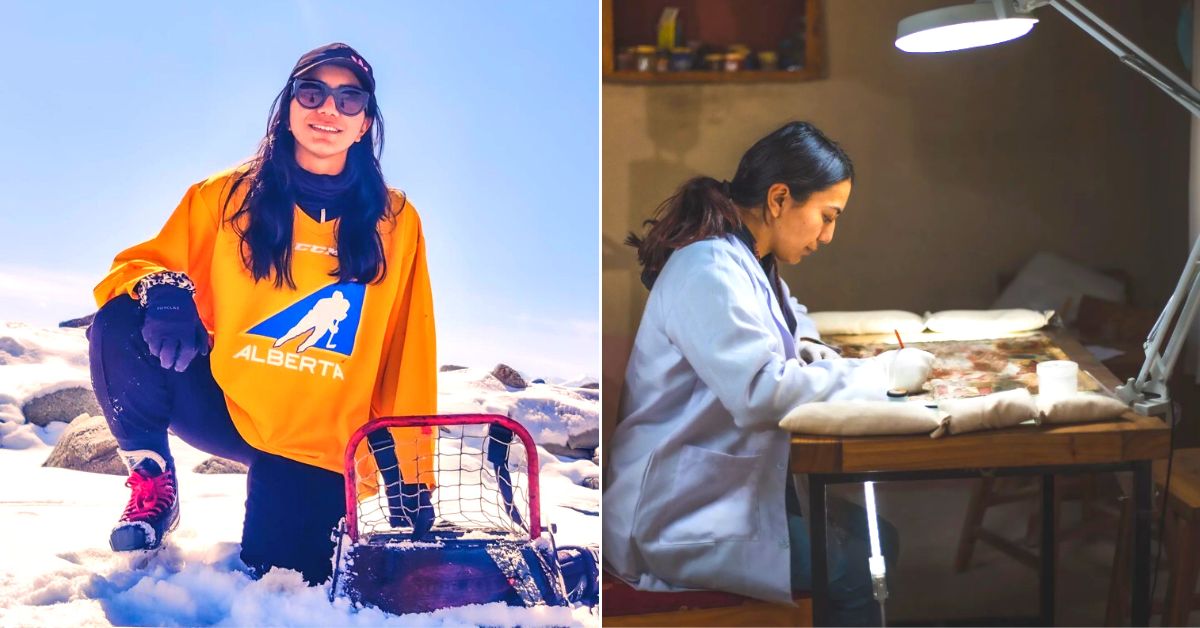
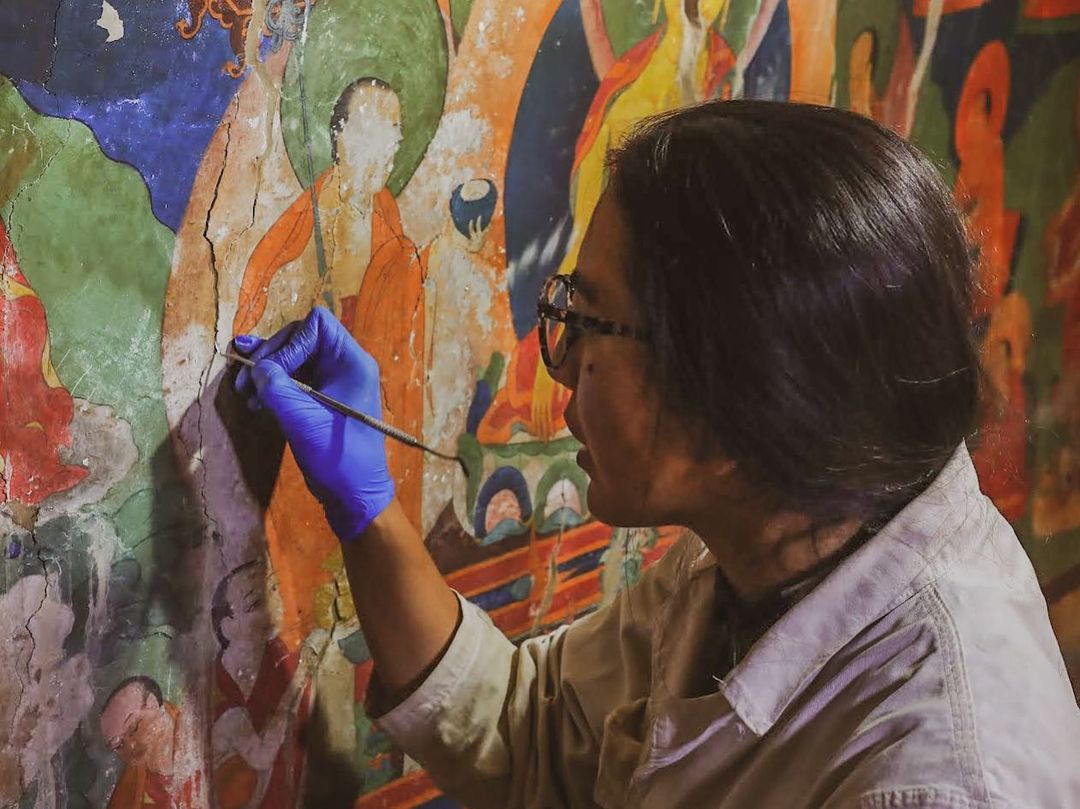
Noor Jahan and her cousin Wajeeda Tabassum co-founded Shesrig Ladakh, an art conservation practice that restores and conserves ancient wall paintings, religious manuscripts, thangka (Buddhist scroll) paintings and metal works.
How do you protect and preserve culture? It’s a question Noor Jahan – a 32-year-old expert in art conservation and heritage management from Leh – has grappled with for a decade.
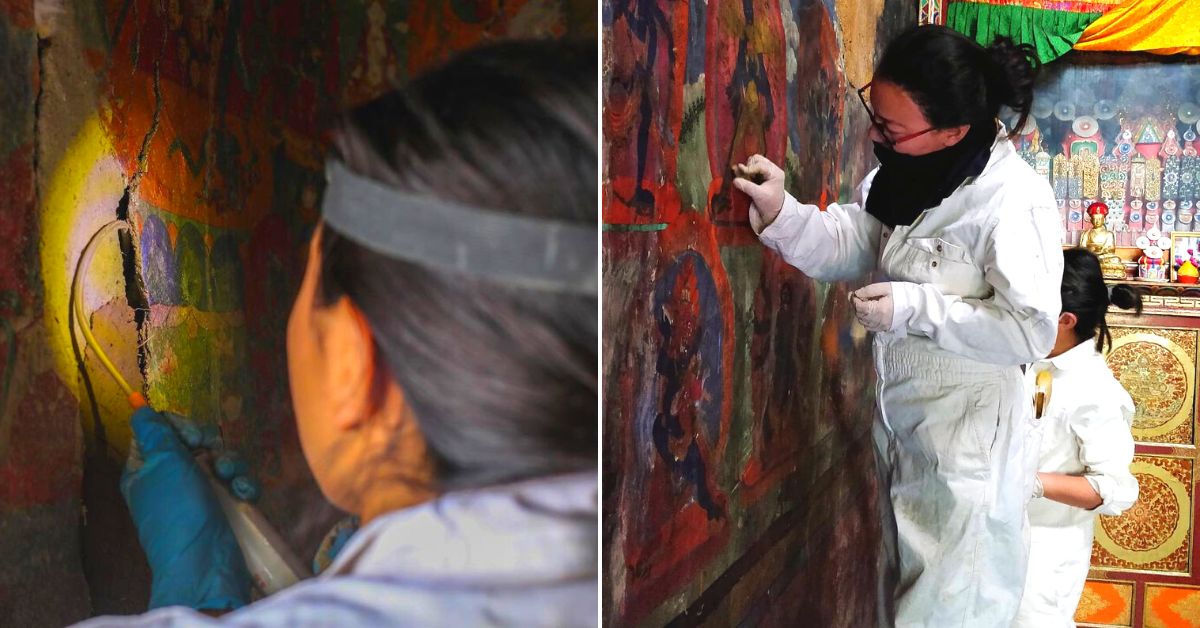
Through Shesrig (meaning ‘heritage’) Ladakh, an art conservation practice she founded with her cousin Wajeeda Tabassum, Noor performs critical restoration and conservation work on ancient wall paintings, religious manuscripts, thangka (Buddhist scroll) paintings and metal works.
“My real interest lies in working on ancient wall paintings and thangka paintings,” says Noor Jahan in a lengthy conversation with The Better India.
Backed by a Master’s degree from the Delhi Institute of Heritage Research and Management (DIHRM) and a PhD from the National Museum Institute, she has worked on wall paintings dating back to the late 8th century and Buddhist thangkas from the 19th century. Also, since 2019, she has run Shesrig on her own following Wajeeda’s departure for foreign shores.
What’s more, Noor is also the goalkeeper for the Indian women’ ice hockey team. Earlier this year, she helped India finish second in the Union Women’s Ice Hockey Tournament in Dubai. Noor reckons that she has a few more years left before she “officially retires” from the sport.
By all accounts, it’s an extraordinary way of life, and this is her story.
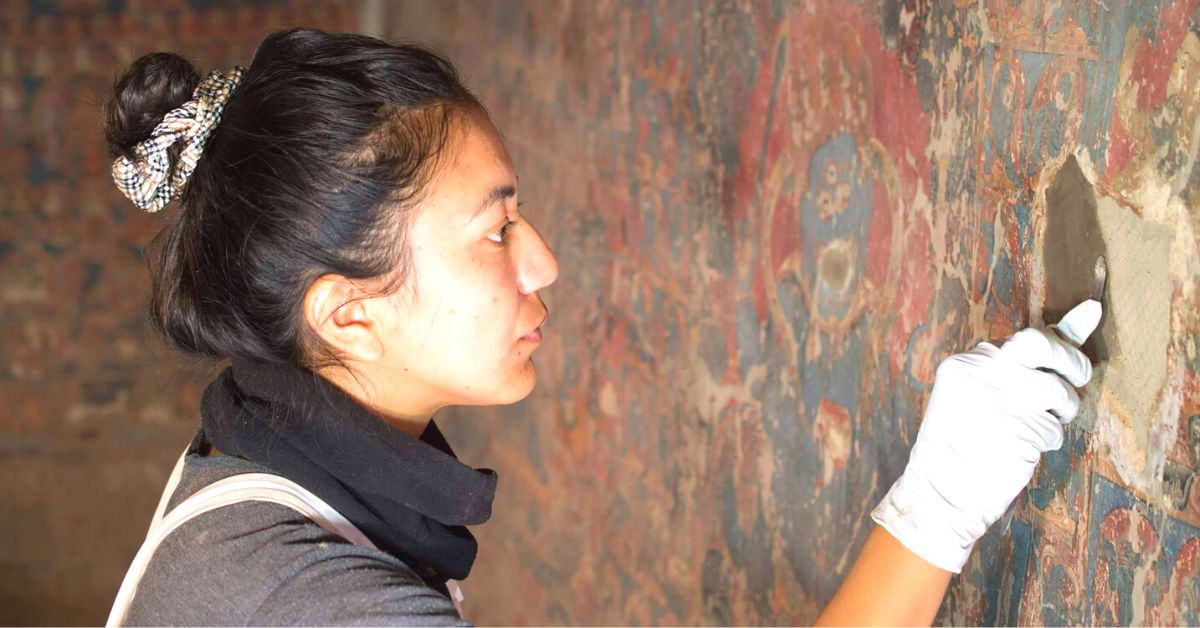
Noor Jahan working on old wall painting in Saspol caves, Ladakh
A serendipitous journey
There was a void in Noor’s life after earning her bachelor’s degree in commerce from Delhi University. Going through the motions, she had no passion for what she was learning. To reflect on what was next and enjoy a short holiday, she left for Leh after graduation in 2011.
It was during a walk through Leh’s crowded old town, when she met a few foreign conservators from the Tibet Heritage Fund working on an old Buddhist temple. Intrigued by what they were doing, Noor engaged in a short chat with them which would change her life.
After returning to Delhi, she began reading up on art conservation and learnt that she could pursue higher studies in this field.
What also sealed the decision to get into this field for Noor were memories from her childhood.
“My mother is from Hunder village in Nubra. Every holiday, we would always visit Nubra to meet my maternal grandparents. The bus would stop at this location called Chamba on the main road from where you had to walk inside the village. This particular route holds great importance in my life now because there are many stupas along the way. Every time I would look up at these pathway stupas, I would see these old paintings. But each passing year, some part of these paintings would disappear. When I applied for this course at DIHRM, the first thing I thought about were these paintings and the conservation work I could do someday,” she recalls.
Allied with a strong desire to come back home, starting this course brought passion back into her life. “Everything I was studying there found a purpose in Ladakh,” she says.
Noor Jahan found purpose in preserving Ladakh’s heritage
Finding Shesrig
Following the first year of her Master’s programme in 2012, Noor and Wajeeda opted to do their internship with the Himalayan Cultural Heritage Foundation (HCHF), a Leh-based non-profit. Helping them find projects to work on was Dr Sonam Wangchok, founder secretary of HCHF.
During this internship, the first major project Noor got involved in was a wall painting at Diskit Gompa, a 14th-century Buddhist monastery in Nubra Valley.
She recalls in an Instagram post, “The internship entailed working on the restoration of wall paintings from the 17th century under the supervision of art conservators from [the] Czech Republic. This was my first hands-on experience where I had the opportunity to conserve sacred Buddhist art and the opportunity to stay at the monastery itself. I think that internship changed my life forever as I not only got to work on the most beautiful wall paintings but gave me the opportunity to meet and interact with the monks at the monastery who took me and Wajeeda in as their own.”
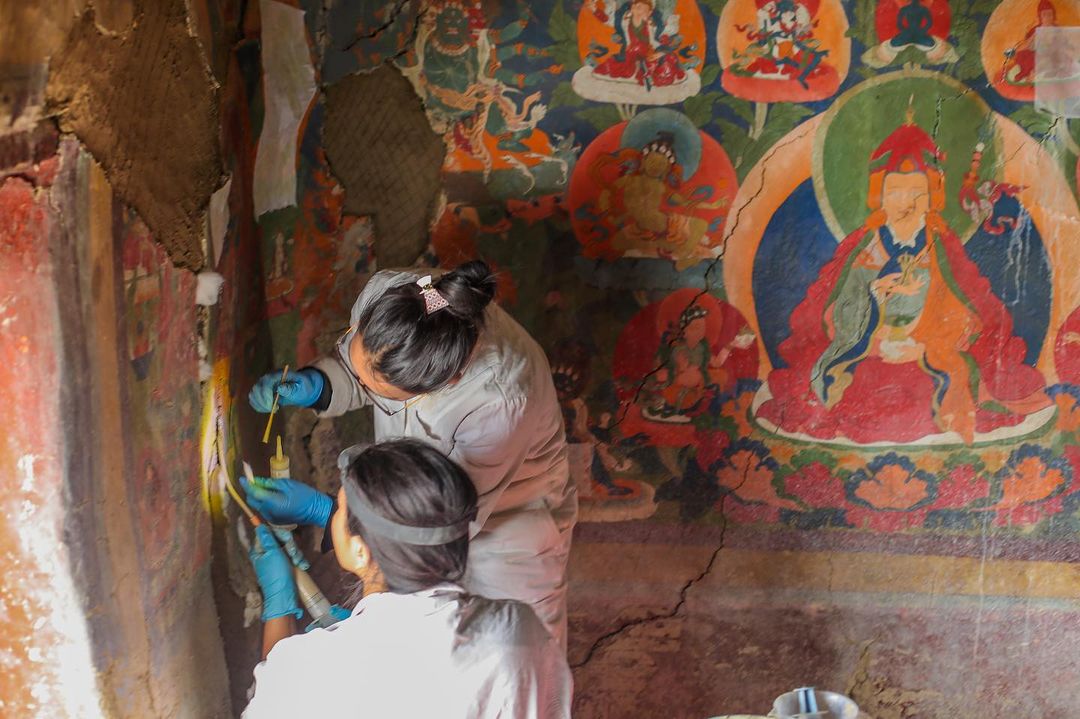
Conserving ancient wall paintings is a delicate process
After completing her Master’s programme in 2013, Noor came back to Leh to work with other organisations like Art Conservation Solutions and Achi Association, amongst others, as a freelancer. In 2014, she worked on her first project outside Ladakh at the Golden Temple in Amritsar with Heritage Preservation Atelier, and also commenced her PhD at the National Museum Institute. Despite these landmark moments, she knew this sort of freelance work wasn’t sustainable.
“Working in these organisations was a great learning experience and helped me to capture some of the finer nuances of conservation. Even today with Shesrig, I collaborate with most of them. But this kind of work wasn’t sustainable, i.e. it was limited to summer months,” she says.
“In the summer, I would work on many projects. But the moment winters came, all these organisations would stop their work in Ladakh. I really wanted to start something of my own in Leh, while working sustainably and throughout the year,” she adds.
Thus, in 2017, Noor and Wajeeda founded Shesrig Ladakh and rented out a historic structure called Choskor House as their base in Leh’s old town, which they had to first restore.
This three-storied structure is located right behind the Jama Masjid (mosque) in the centre of Leh along the hillslope. It belongs to a renowned family of traders, who along with other important families, once led important trade missions to Lhasa from Ladakh.
“Even though Choskor House was really old, we decided to rent it. To restore it, we had initially consulted some architects, but there came a point when it became difficult because of costs and time constraints. That’s when we reached out to Achi Association India, a sister organisation of Achi Association (a Swiss-based organisation), which took over the project of restoring this structure backed by funding from the German Embassy. They helped with establishing the studio in which we currently operate. We started working inside our studio only this year,” says Noor.
“It’s important to see your heritage as an inheritance that has great value,” says Noor Jahan
Conserving ancient wall paintings is a delicate process
Conserving wall paintings
Conservation and restoration are different acts. Noor explains, “In conservation, people do not recreate anything new. So, if there are losses in a given wall painting, there is no recreation but only stabilisation. Restoration, meanwhile, seeks to recreate some of those losses.”
Some of the fundamental challenges in conserving or restoring old artworks include physical access to remote sites and obtaining the necessary materials that they largely import.
Noor gives us an example of a project they worked on in collaboration with the Himalayan Cultural Heritage Foundation in June 2020 to illustrate her point. The site was Chomo Phu, a small one-room Buddhist shrine near Diskit Monastery, Nubra.
“It’s quite a steep hike up from Diskit Monastery, and there is a gorge inside the valley where this shrine is located. There was no place for accommodation. Instead, we pitched tents next to the shrine and had to improvise basic facilities. We camped in that valley for about 25 days since it was not practical or possible for us to hike from there to the monastery or the village every day,” she recalls.
Before, during and after the project, Noor and her team do extensive documentation work. During this phase, they closely examine the kind of deterioration the wall painting has undergone.
In this particular case, there were a lot of over-filling and historical fills done in the past. These fills were done in such a way that it was obscuring a lot of the original painting and sometimes even overlapping it. They had to carefully remove those historic fills.
“Another issue with wall paintings is that there are a lot of detachments. In the event of any structural movement or water seepage, the plaster gets detached from the support, thus creating these hollow areas inside the painting. You can discover these hollow areas through a percussion test (a method for the structural inspection of wall paintings). We then perform grouting, i.e. fill the gaps between the painting and the support structure,” she notes.
Apart from these, there are cases where the paint layer gets delaminated. To address this, they use a consolidant and then stick the paint layer back to the surface.
“Of course, there is cleaning work which is done. The paintings are largely glue-bound tempera (also called secco, which are paintings on dry surfaces). In this kind of technique, the pigment is usually mixed with the binder and then applied to the walls. With water infiltration, the binder becomes weak causing delamination of the paint layer,” explains Noor.
“This damage primarily occurs because of water. We make sure not to perform any wet cleaning, i.e. don’t use any solvents to clean the wall painting. We only employ dry cleaning. There are various types of conservation-grade sponges which we work with and soft brushes to remove the dust or any mud infestations,” she adds.
A major point of contention with wall paintings is retouching work (reworking small areas of a painting to cover damage or to mask unwanted features).
Without getting too deep into the subject, when it comes to wall painting conservation work, Noor and her team largely stick to what she calls “conservation or stabilisation work”.
“It’s important to see your heritage as an inheritance that has great value,” says Noor Jahan
Restoring old thangkas
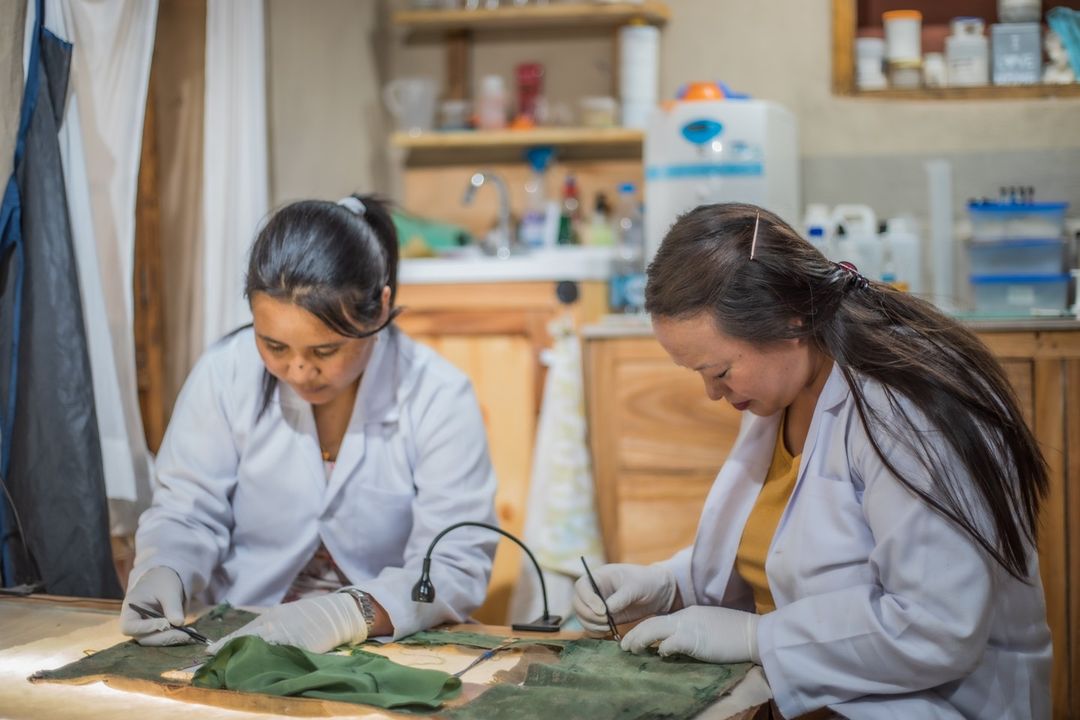
This year most of the thangkas that were brought in for restoration at Shesrig’s studio came from private households. Each thangka arrives in a different condition.
In thangka paintings, you have a textile-based canvas made of cotton fabric or any other material used by the artist in the centre. These thangkas also usually have either silk or brocade borders. Most thangkas they got into their studio this year had silk borders.
Step 1: “Since the thangka has come directly from the chod-khang (prayer room) to our studio, we first take it to a nearby monastery, where a de-consecration ceremony is done,” she says.
Step 2: The next step is to bring the thangka back to the studio, perform extensive documentation work including photographic documentation and understand what kind of problems are visible. Accordingly, they prepare a treatment plan.
Step 3: Usually the centrepiece of the thangka is stitched with a textile border. They separate both elements because the fabric at the border is completely different from the canvas in the centre. Following separation, they work on the border and centre piece canvas separately.
Step 4: Once the separation is done, the first step is cleaning the soot. “In thangkas, there are times (only when required), when we go for mild solvent cleaning but once again dry cleaning methods are preferred. Also, solvents can sometimes be harsh. We have started preparing gels which are much milder and do not adhere to the surface for the cleaning process,” she says.
Step 5: What if there are big losses or tears on the thangka painting? “We make a similar kind of ras-jee (the local term used for the textile canvas of a Thangka painting) in the studio. We use pieces of that ras-jeeto mend the tears. Otherwise, in thangkas, we also see a lot of cracks. To fill the cracks, we use the markalak (local clay mixed with mild adhesive) to fill those cracks because that’s part of the original technique of preparing a thangka. We follow the same methods while restoring it as well,” she explains.
Step 6: Once this is done, if there is any consolidation work required or a paint layer is coming off, they fix those problems. Sometimes, they mend the tears fibre by fibre, which requires very delicate hands. Also, if there are any small losses or paint losses, they do subtle retouching work using natural colours or the colours originally used on the thangka.
Conservation of Thangsham (the local term used for the textile border of a Thangka painting)
Step 7: Meanwhile, there is another team which is working on the textile border known as thangsham locally. There is a particular method of washing the textile using conservation-grade detergents.
“We don’t dip it straight into the water. Instead, we use wet sponges to clean it very meticulously. Sometimes these borders are also torn or otherwise in a bad condition, for which we mend them using patchwork with silk, brocade or whatever material was originally used. We have a stock of raw silk, which is white. We dye it as per the thangka’s requirements. If the thangsham, for example, is blue, we will dye the silk blue and do the patchwork from the inside. We perform the process of dyeing ourselves at the studio,” she explains.
Step 8: Once both elements are ready, they stitch the centrepiece canvas and the border back together, following which a consecration ceremony is done and then returned to the client.
Once again, depending on the state in which the thangka is sent, it takes anywhere between a fortnight to two months or more to restore a thangka. It also depends on manpower.
“Most of the time, we work in groups of two or three women on one thangka, and depending on the scale of the task, it takes about a month or two if the damage is extensive,” she says.
Given that most of the conservation work she does with Shesrig Ladakh relates to Buddhist heritage, questions have emanated from either side of the religious divide.
But is her faith an obstacle in this line of work?
“Most of the time, they don’t see my Muslim faith as an obstacle to the work that I do. For the most part, I’m not treated as an outsider or not from the community. In fact, it has been the opposite, where I am given more respect and love, especially in monasteries,” she says.
However, recently she heard someone say, ‘What is this Muslim girl doing here?’ “Look, this is how the world around us is moving. As Muslims in India, we know what’s going on. But I do not take these comments personally because I have to do what I know how to do,” she says.
Noor Jahan: “I have to do what I know how to do”
But such ad-hominem comments don’t necessarily come from the Buddhist community. She even notes how members of her religious community pass judgement on her line of work.
“Sometimes, people from the community approach my family to complain about my work, but fortunately they have been very understanding,” she notes.
Another struggle Noor deals with is the significant lack of awareness in Ladakh about art and heritage conservation as a field. “Even though they support me, my parents and some friends still don’t understand the kind of work I do. They still think this is a ‘hobby’ to me and don’t take me seriously. Even though the conversation in Ladakh about restoration and conservation has progressed a little, there are still people who think that this work can be done for free. This is something, I hope, changes with time as the conversation around this subject grows,” she says.
Simrah Mir, a Kashmiri student, beat the odds to score 99.39 percentile in JEE Mains, inspiring countless students.
Simrah Mir, a JEE topper from Kashmir. | Photo by Special Arrangement
She comes from a region where resilience is a way of life. When Simrah spoke over the phone, her voice exuded conviction which only comes with a sense of achievement.
“At one point, I felt like giving up,” she began. Yet even her recall of desperation was in an unwavering tone.
Hailing from Kashmir’s Pulwama, a town often making the headlines for more negative than positive news, Simrah Mir has given a reason for the region to shine bright. Defying all odds stacked up against her, this young woman has brought immense joy and pride to the valley by scoring 99.39 percentile in the recently concluded JEE Mains this year.
Simrah’s is not just a personal victory but may well be an inspiration for countless students across Kashmir. Simrah, a student of a local government school, attended RISE coaching classes in Srinagar for JEE.
RISE is a coaching institute in Srinagar started by three former IITians: Salman Shahid and Imbesat Ahmad, both alumni of IIT Kharagpur, and Mubeen Masudi of IIT Bombay. Mubeen is a Kashmiri, says Mr. Shahid. “We started our institute in 2015 since we wanted to do something for Kashmir. When we started out, only a handful enrolled in our classes. Today, every year, some three to four students from our institute go to IIT and 70 to 80 students go to NIT. Twenty percent of these students are girls,” says Mr Shahid.
In an interview with The Hindu, Simrah spoke about her challenges, triumphs, and her fresh optimism for the road ahead.
She says: “At times, there were internet shutdowns, and many times it was a fearful environment at my hometown. My parents sheltered me from everything, even from what happening around our near vicinity. Then I moved to Srinagar. It was difficult to travel up and down daily from Pulwama every day for the coaching classes. It’s a long distance.”
Unlike many students who set their sights on JEE early on, Simrah’s decision to pursue engineering evolved over time. “It was a big step. Initially, I didn’t know much about JEE. I joined the RISE Institute, and there I got to know about the exam and started looking at engineering as a career. Later, I faced difficulties in my preparation. I felt like giving up, but my parents constantly supported and motivated me,” she continued.
What kept you motivated? What were the reactions of your parents, friends, and teachers to your preparations?
Initially, when I was searching for an interest, my parents and relatives were pushing me towards medicine. I didn’t like Biology and I’m not interested in Medicine. From an early age, I was interested in Physics and Mathematics; I wanted to know about the subjects. I studied by myself. I used to read books other than my textbooks. Physics and Maths interested me.
Later on, I decided that it is a stream for me. I decided I had to take Mathematics and Physics as a career.
Any obstacles or resistance you came across while preparing for JEE? Did you ever think about what would happen if you didn’t get selected?
There were definitely moments of doubt. And I used to have them often. As I said, I felt like giving up. JEE is a tough exam. I did think about what would happen if I didn’t get selected. But every time I felt low, my parents supported me. That helped me stay focused and push through the tough times.
I recently spoke to some people in Assam and learned that language, infrastructure, and cultural barriers can be obstacles in education. Did you face any challenges like that?
Shifting to Srinagar was a big deal for me. I’m from Pulwama, and it was getting difficult. There were no coaching classes specifically for JEE preparations
I did think of going to Delhi or another State initially because there are good institutes there. But then I realised it might not be beneficial for me. I have never lived alone, and I felt like I should be close to my parents.
In Kashmir, students usually prefer medicine and becoming doctors, especially girls. It’s rare for a girl to take engineering as a career.
Did your school play any role in your success? Did they provide career counselling or extra classes for JEE aspirants?
There was enough career counselling but no extra classes specifically for JEE aspirants. Most students in my school focused on board exams.
Nobody actually introduced the subject to me. I was inquisitive. There were some other students too who were genuinely interested to study and were inquisitive like me.
Which branch of engineering attracts you the most? And why? And have you thought about any specific college you would like to join?
I have not thought about it. Of course, I want to go to the best college. I want to go to IIT.
Personally, I want to take Computer Science Engineering, but I don’t know exactly what will happen in the future. I haven’t researched much yet. It also depends on my rank and how I perform in the JEE Advanced exam.
What do you wish to become eventually?
As of now, my goal is to pursue Computer Science Engineering. I would see where my passion takes me eventually.
What advice and tips you would want to give to JEE aspirants from your region?
In Kashmir, many students, especially girls, hesitate to choose engineering because it’s not the common path. But if you genuinely enjoy Mathematics and Physics, you should give it a chance. It’s important to be practical.
JEE is tough, and there will be challenges. But if you take it step by step and stay disciplined, you can do it.
source: http://www.thehindu.com / The Hindu / Home> Education / by Mantasha Ahmed / February 15th, 2025
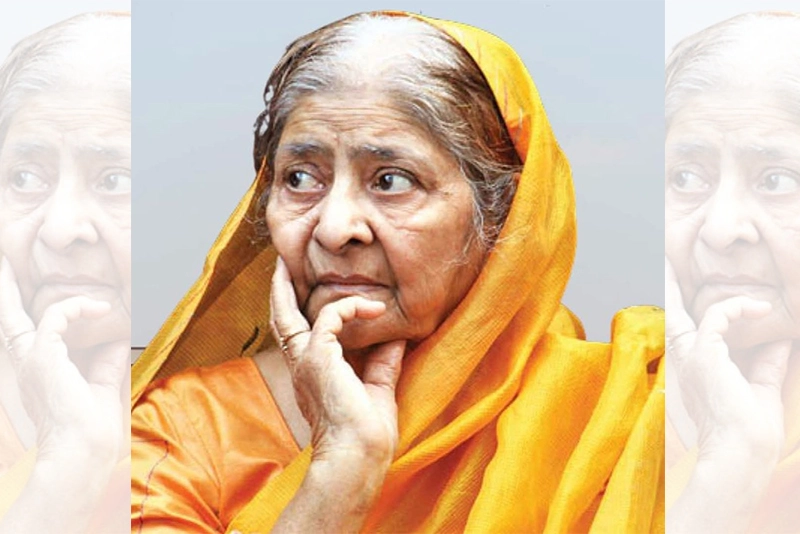
Zakia Jafri, wife of former Congress MP Ehsan Jafri – the Legal Crusader who became a Symbol of Resistance, died at her residence in Ahmedabad Saturday February 01, 2025.
Mumbai:
Zakia Jafri, wife of former Congress MP Ehsan Jafri – the Legal Crusader who became a Symbol of Resistance, died at her residence in Ahmedabad Saturday February 01, 2025.
Zakia Jafri was 86.
Zakia Jafri is survived by sons Tanveer and Zubair, and daughter Nishrin. “Mom passed away at around 11:30 AM”, she told media.
Zakia Jafri’s sad demise was later shared with the world by Rights Activist, Journalist and Author, Teesta Setalvad.
“Zakia Appa a compassionate leader of the Human Rights Community passed away just 30 minutes ago!” Teesta Setalvad wrote on her X account around 01:30 PM Saturday.
“Her visionary presence will be missed by the nation, family. friends & world! Rest in Power and Peace Zakia appa!” Teesta wrote while condoling Zakia Jafri’s death.
Originally from Khandwa district of Madhya Pradesh, Zakia Jafri had shifted to Ahmedabad, Gujarat in 1971. This after living in a refugee camp after her home in Khandwa was burnt during the 1969 communal riots.
Zakia Jafri’s husband Ehsan Jafri was a freedom fighter and Member of Parliament.
Ehsan Jafri and his family had provided shelter to dozens of Muslim families at their Gulbarg Society in Ahmedabad during the 2002 Gujarat riots.
But, the society, considered to be a safe haven because of Jafri family’s stature, too was targeted by the rioters who burnt alive and killed at least 68, including Ehsan Jafri.
Zakia Jafri later fought a long legal battle to seek justice for the 2002 Gujarat riot victims. She had also challenged the SIT clean chit given to Prime Minister Narendra Modi, who was Chief Minister Gujarat, during the riots.
During the long legal battle she was threatened and later cajoled by different means and tactics. She however remained firm.
Zakia Jafri is likely to be laid to rest beside her husband in Ahmedabad.
Condolences pour in
Meanwhile, condolences are pouring in from different circles after the demise of Zakia Jafri.
Kerala Chief Minister, Pinarayi Vijayan, in his condolence message said, “Zakia Jafri, an unwavering voice for the victims of the 2002 Gujarat riots, is no more. The widow of former MP Ehsan Jafri, who was brutally murdered by a Sangh Parivar-led mob, she dedicated her life to the pursuit of justice. Her relentless fight leaves behind a legacy of courage and resilience. Her memory will continue to inspire us in our fight against communalism and divisive forces.”
Congress Spokesperson, Pawan Khera, wrote, “Zakia Jafri died today. Her Hope for justice had died in her life time. She chronicled the history of ‘New India’ through her tears, her sobs, her fight and her defeat.”
Hyderabad MP and AIMIM Chief Asaduddin Owaisi in his condolence message wrote, “Zakia Jafri watched her husband being murdered by a mob in 2002. For nearly two decades, she fought a lonely legal battle against some of India’s most powerful men, never showing fear. She passed away today. May Allah grant her peace and strength to her loved ones.”
Sanjiv Bhatt (IPS) who was posted in Gujarat during the 2002 Godhra Riots condoled Zakia Jafri’s death in these words.
“Zakia Jafri Ji was an unshakable voice of truth against power. For decades, she fought not just for justice, but for truth, dignity and the very soul of our democracy. Her strength in the face of unimaginable loss will forever inspire us. Today, India has lost a true warrior, but her courage will live on! Rest in power, Zakia Ji!!”
Condoling the death of Zakia Jafri, Journalist and TV Anchor Rajdeep Sardesai worte: “Sad news: Zakia Jafri, whose husband and former Cong MP Ehsan Jafri was brutally killed in the 2002 Gujarat riots passed away today. For years, she fought a valiant battle for justice. When even an MP’s wife struggles to be heard, imagine the plight of an ordinary citizen. And yet, she remained steadfast and courageous till the end. Refused to give up.”
Mumtaz Patel, daughter of Congress leader Ahmed Patel, condoled Zakia Jafri’s death in these words.
“Zakia Jafri ji, symbol of resilience and an unwavering voice for justice, is no more. Her fight for truth and accountability in the face of unimaginable tragedy will always be remembered. May she rest in power.”
My heart goes out to the brave lady #ZakiaJafri who fought against these devils and those three judges who betrayed you . But they all will have to pay for their karmas before they depart from this world,this also includes the supreme leader . pic.twitter.com/JQUZTueTuI— Ravinder Kapur. (@RavinderKapur2) February 1, 2025.
“Zakia Jafri, widow of former parliamentarian Ehsan Jafri, who was killed by a Hindutva mob in the 2002 Gujarat genocide, Zakia Jafri Survived in genocide and become the relentless voice of Justice”, Noor Mahvish, a lawyer, wrote on X.
“Zakia Jafri . A life time of a fight for justice 23 years out of the 85 she spent on this earth ,waiting for justice for the killing of her husband along with the people they tried to protect inside Gulberg Society in Gujarat 2002”, a social media user, who identifies her as Realm of Bohemia, wrote.
“Brave and fearless, she fought for Justice till the end”, an activist wrote.
“She left this world fighting for justice and showing the whole world how to never give up”, Razia Pathan, an activist, wrote.
source: http://www.ummid.com / Ummid.com / Home> India / by ummid.com News Network / February 01st, 2025
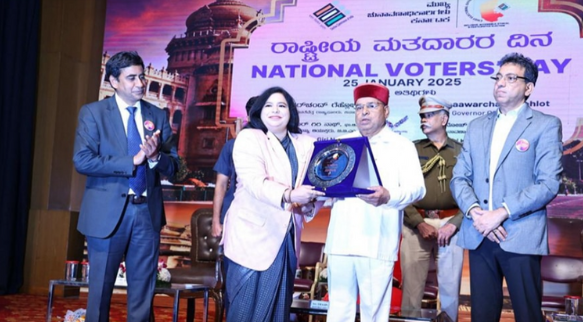
Anjum Tabassum, Tahsildar of Humnabad in Bidar district of Karnataka was presented with an award for her excellent performance as Assistant Electoral Registration Officer during Parliamentary elections 2024.
State governor Thawarchand Gehlot gave away the award to her on National Voters’ Day in Bengaluru on January 25.
This prestigious recognition is a testament to her outstanding efforts and dedication during the Lok Sabha Elections 2024. Her hard work has paid off, and this award is a well-deserved acknowledgment of her commitment to ensuring free and fair election.
Anjum Tabassum Lashkari from Gulbarga cracked the Karnataka Administrative Services (KAS) in 2014. She did her masters from Gulbarga University and had schooling earlier in Shahbad town.
source: http://www.radiancenews.com / Radiance News / Home> Pride of the Nation> Awards> Latest News / by Mohammed Atherulla Shariff / January 27th, 2025
Human trafficking is the illegal process of moving or luring a person from one place to another using deception, threats, pressure, duress, or other abusive means for financial gain. Most of them trafficking children are pushed into the sex trade.
Fifteen years before, she was a victim of human trafficking. Today, leaving her past behind, Naseema Gain, 28, has rescued more than 4,000 women from the flesh trade and is helping them lead a normal life, reports Awaz The Voice.
“It was 2009. I remember there was a Puja function at my school on that day. I was happy. I have known him since childhood, as his uncle lived in our village. I and my friend happily sat in his car when he offered to drop us at our place. Little did I know this incident was going to change my life. When I regained consciousness, we found ourselves at an unfamiliar place. I had no idea where I was.” The 13-year-old Naseema Gain had no idea that she had landed in the net of human traffickers.
Born in Maslandpur, West Bengal, Naseema Gain had a happy childhood till an acquaintance kidnapped her on the pretext of offering her a ride to school.
Fortunately, she was released after 10 months. However, she faced a bigger tragedy on her return home when she found people looked at her and treated her differently. Due to prejudices, people didn’t treat her as a victim.
Naseema didn’t give up. Today she is helping hundreds of girls who are victims of human trafficking by rescuing and rehabilitating them.
Narrating the incident of her kidnapping, Naseema says, “He asked me and one of my friends if we would like to go home in his car. There was also another person in the car. Not knowing his intentions, we happily sat in the car. He took us to a deserted place and dropped us saying that he would return after some time.
“After a while, a person came in another car and said that he would drop us home. It was dark, so we accepted his offer least knowing that this lift would turn was going to change our lives.”
They sold Naseema and her friend in Bihar. On her life in a brothel, Naseema says, “They taught us to dance and sing. If anyone did not obey them, they were beaten, tortured, and made to starve. We had lost all hope of returning home.”
She says violence, torture, and starvation were routine punishments for the inmates of a brothel. One day Naseema and her friend were sold as maids. This gave them a chance to escape.
Naseema worked as a house help for a professor. “Slowly I started following their language. One day I told him about my story of being kidnapped and sold and asked him to help me return to my home. I somehow managed to gather the courage to tell this to him.”
She also told the professor that if he didn’t help them and sent them back to the agency, the girls would face torture and be resold.
The professor asked her to provide him contact number of her home. Naseema didn’t remember hers but her friend had memorised her telephone number. The kind-hearted professor called the number and both the girls were rescued with the help of the police.
However, before the police and the parents could reach Naseema and the other girl, the trafficker came to know about this. He called the Professor who shifted them to different secret locations for safety. After tracking them for several weeks, Naseema and her friend were finally freed after 10 months.
Naseema says, “It still feels surreal to be rescued and taken home. I had lost all hope, but our and the police’s efforts would be successful. I am very grateful to those professors.”
Her family was happy at her rescue and return home but the villagers were not ready to accept her.
“This is the sad truth of our society. I was a victim of circumstances, and yet had to face ostracism.” She adds, “Parents would tell their children not to speak with us,” she says.
She said, “We were not allowed to go to school because the school refused to admit us.”
“Ten months of torture and then this kind of treatment from society alienated me. I didn’t leave my house for the next five years,” she says, “Even after coming out of the quagmire of human trafficking, I was saddened by the ostracism by society.”
Naseema’s parents contacted an NGO which was into counselling of human trafficking survivors. Naseema says that counselling gave her a lot of strength. She was convinced that she could only counsel those who had survived this inhuman quagmire. She contacted girls and women who had been rescued from human traffickers and brothels and helped them.
Naseema says, “I have tried to build a life with whatever I have. Call it courage, hope, or luck. That is why I dare to help others. To help more girls like me, I started working with ‘Utthan Collective’, an organisation that provides training, counselling, and support to girls and victims.
She says victims like her are treated like criminals even after their rescue. She wants to create a new identity for all such victims.
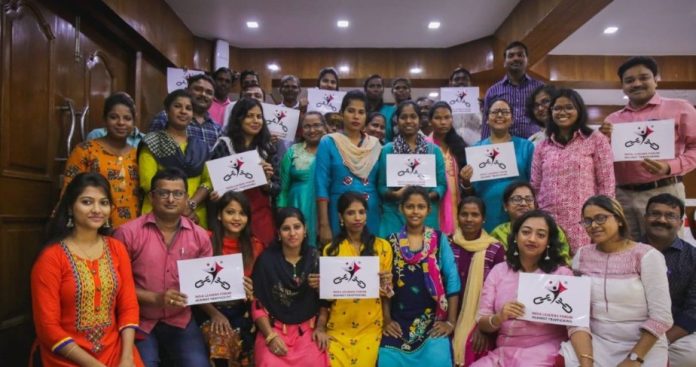
In 2019, Naseema co-founded the Indian Leadership Forum Against Trafficking (ILFAT) with similar anti-trafficking groups across the country. The organisation’s work spans across nine states and has given a new direction to the lives of more than 4500 victims.
She adds, “A person who has gone through such a situation needs a lot of care, love, and respect. In the process of trafficking, they have lost all their self-esteem. Often, society rejects them; in many cases, even their families disown them. We provide them with the necessary help and shelter.”
The organisation trains victims in various skill-based jobs and helps them earn a livelihood. “We reach out to victims and provide them with mental health support and counselling. Through outreach programmes, their trauma and grief connect. So, they don’t feel any loss there. This helps them move forward,” Naseema says.
About her work, Naseema says, “Many times different NGOs approach me and learn how ILFAT and Utthan work. This is a huge inspiration and victory for me.” She adds, “With the organisation, I want to create a safe environment for the victims, ensure that the culprits get proper punishment and all the surviving girls are rehabilitated.”
Naseema, along with her colleagues, helps improve the mental health of the girls who have been rescued from the quagmire of human trafficking, provides compensation, makes the girls aware of their skills, and nurtures them by giving them necessary training.
source: http://www.radiancenews.com / Radiance News / Home> Education> Latest News / by Mohammed Atherulla Shariff, Radiance News Bureau / January 28th, 2025
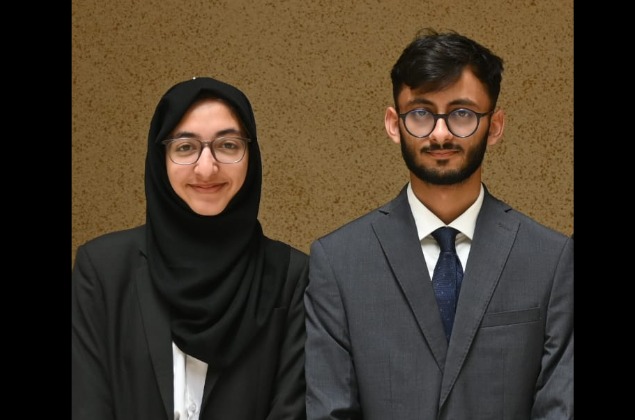
Zainab-ul-Kubra (3rd year), and Intizar-ul-Islam (4th year), Prize winners from NUSRL
Ranchi:
Students of National University of Study and Research in Law (NUSRL), have secured first place in the International Arbitral Award Writing Competition. Two university students, Intizar-ul-Islam (4th year) and Zainab-ul-Kubra (3rd year), achieved the top honour in the 5th Surana & Surana RGNUL International Arbitral Award Writing Competition 2024.
This is a significant achievement for the university, as the duo won this accolade by outperforming participants from some of the most renowned universities in India and abroad. The competition was organised by Center for Alternative Dispute Resolution (CADR) at Rajiv Gandhi National University of Law (RGNUL), Punjab, in collaboration with Surana & Surana International Attorneys.
Participants were tasked with drafting an arbitral award based on a hypothetical legal problem.
More than 72 contestants took part, including students pursuing BA-LLB, LLM, PhD, MPhil, or other law-related courses. The competition deadline was October 30, 2024, and the results were announced in January.
Based on their exceptional skills, Intizar and Zainab not only secured the first position but also received a cash prize of ₹25,000 for their victory. Their success highlights their dedication and expertise in the field of law. The competition served as an excellent platform for students to showcase their legal writing abilities.
The Vice-Chancellor of the university, Professor Dr. Ashok R. Pal, congratulated Intizar and Zainab on their achievement.
source: http://www.radiancenews.com / Radiance News / Home> Pride of the Nation> Awards> Latest News / by Radiance News Bureau / January 21st, 2025
Khazima practised 12 hours daily for months to prepare for the championship.
Deputy CM Udhayanidhi Stalin awarding Rs1 crore cash to M Khazima (Photo | Express)
Chennai :
Three TN women dominated the Women’s Carrom World Championship. M Khazima (18), the youngest world champion, who competed in doubles and team events, received Rs 1 crore from the state government. Mithra (17) and Nagajothi (26), who won the doubles and team events, received Rs 50 lakh each from Deputy Chief Minister Udhayanidhi Stalin in a felicitation conducted by Sports Development Authority of Tamil Nadu (SDAT).
Khazima practised 12 hours daily for months to prepare for the championship. Mehaboob Basha (her father), an autorickshaw driver, runs the Cherian Nagar Carrom Coaching Club with 45 members. “This is a huge recognition,” Khazima said.
“My brother, Abdul Rahman (26), a Junior National Champion, quit playing due to our financial condition. We live in a rented house, and my father’s club is also in a rented space.” She added that the government has promised to improve the club and revealed that she plans to buy a house with the money.
Mithra’s father also drives an autorickshaw. She learned carrom when she was in Class 5. She said her father bought her a carrom board since none of the people playing carrom in her compound included her. She expressed her dream of buying a house and supporting other players.
Nagajothi was part of the winning team in the Asian Cup. She works as an Income Tax Inspector, selected through the sports quota.
source: http://www.newindianexpress.com / The New Indian Express / Home> Tamil Nadu / by Subhashini Vijayakumar / December 19th, 2024





 What kept you motivated? What were the reactions of your parents, friends, and teachers to your preparations?
 Initially, when I was searching for an interest, my parents and relatives were pushing me towards medicine. I didn’t like Biology and I’m not interested in Medicine. From an early age, I was interested in Physics and Mathematics; I wanted to know about the subjects. I studied by myself. I used to read books other than my textbooks. Physics and Maths interested me.