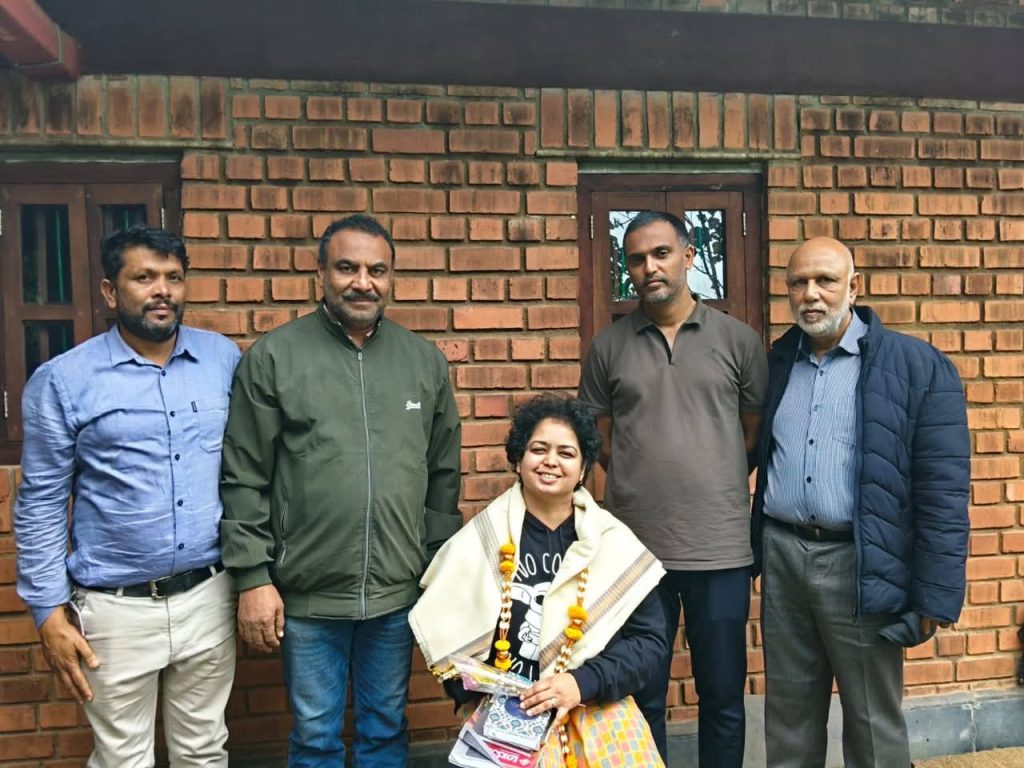
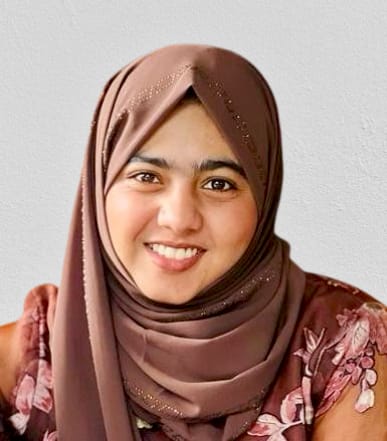
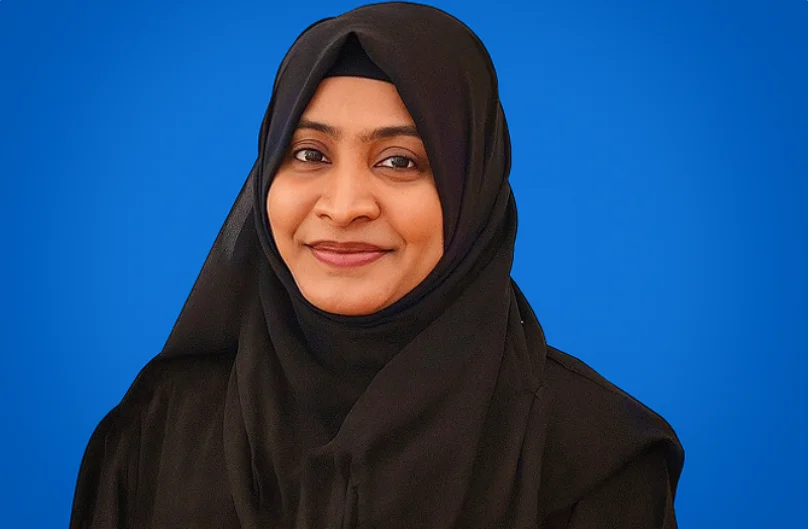
The Jamaat-e-Islami Hind Women’s Unit honored acclaimed writer and Booker Prize winner Deepa Basti at her residence in Madikeri on Tuesday, recognizing her remarkable contribution to literature.
During the felicitation, members of the unit encouraged Basti to focus on promoting human values through her work, highlighting the powerful role of literature in bringing about societal change.
Responding to their thoughts, Basti acknowledged that the literary field holds immense potential to influence social transformation and stressed the importance of sustained efforts in that direction.
The program was attended by Kodagu District Women’s Unit President Muheena Abubakkar, Madikeri President Waheeda Shaukat, and members Bibi Fatima, Maryam Mafeeda, and Tahira.
Also present were District President C.H. Apsar, Madikeri Local President G.H. Mohammed Hanif, members Mohammad Mustafa, and journalist Abdullah, all of whom extended their congratulations and best wishes to Basti for her future endeavors.
source: http://www.thehindustangazette.com / The Hindustan Gazette / Home> News> National> Karnataka / by The Hindustan Gazette / July 12th, 2025
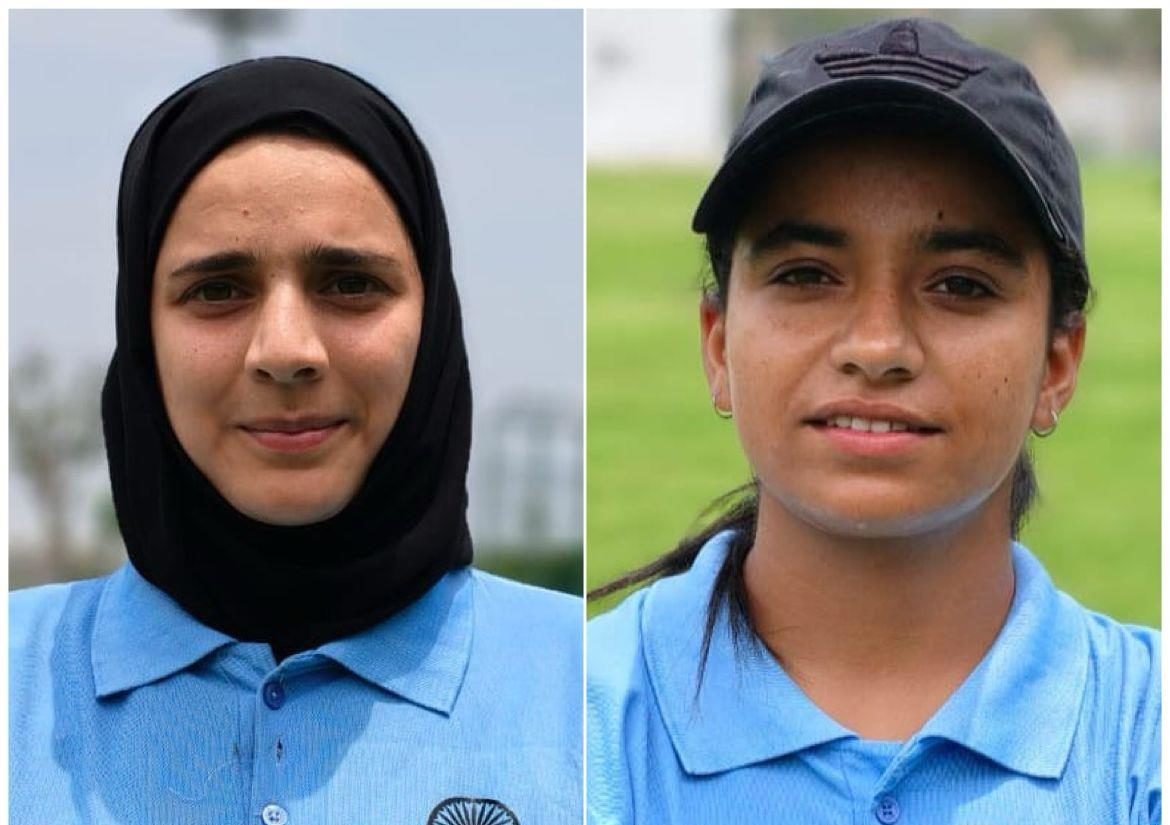
Two players from Kashmir, Shaista Wani of Srinagar and Farhana Rehman of Pulwama
Srinagar:
Two players from Kashmir, Shaista Wani of Srinagar and Farhana Rehman of Pulwama, have been selected to represent India in the Asian Women’s Softball Championship, to be held in Xi’an, China, from July 14 to 20.
Their selection to the Indian national team marks a proud moment for the Union Territory and reflects the growing presence of women athletes from J&K on national and international platforms. Both Shaista and Farhana cleared tough national trials and took part in intensive training camps in Indore and New Delhi.
The Asia Cup is a qualifying tournament for the Women’s Softball World Cup 2026. The top two teams from this championship will advance to the global stage.
Shaista and Farhana have been consistently performing at national events for years and began their sporting journey at a young age.
Their hard work and dedication have brought them to this milestone.
Congratulating the athletes, J&K’s Youth Services and Sports Minister Satish Sharma said their selection is a proud moment for the region. “This shows that girls from J&K are rising in sports and competing at the highest level,” he said.
Sarmad Hafeez (IAS), Commissioner Secretary, Youth Services and Sports, said this achievement reflects strong training, discipline, and athlete development. “Our girls are proving their talent internationally,” he added.
Nuzhat Gul, Secretary, J&K Sports Council, also praised the players, calling them role models for other young girls in the UT. “The Sports Council is committed to supporting female athletes with better training and facilities,” she said. (KNS)
source: http://www.freepresskashmir.news / Free Press Kashmir / Home> Achievers / by News Desk / July 10th, 2025
She calls upon council and the people for concerted efforts to take district forward
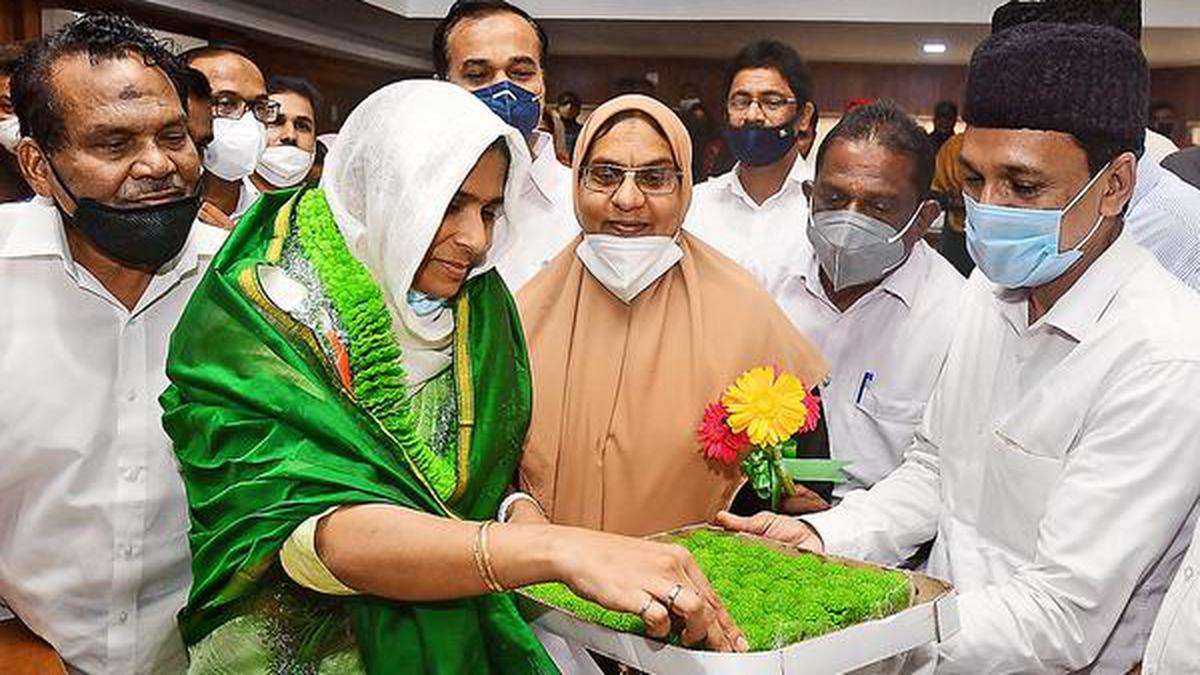
IUML Malappuram district president Sayed Sadikali Shihab Thangal offering sweets to newly elected District Panchayat President M.K. Rafeeka in Malappuram on Wednesday.
Indian Union Muslim League (IUML)’s M.K. Rafeeka was elected president of the Malappuram District Panchayat here on Wednesday. IUML’s Ismail Moothedam was elected vice president.
Ms. Rafeeka became President by winning 26 of the 32 votes. She defeated Left Democratic Front (LDF)’s Arifa Nasar, who got five votes. One vote was declared invalid.
Congress’s N.A. Kareem proposed Ms. Rafeeka for the president’s post, and P. Manaf backed her. Ms. Rafeeka represents Anakkayam division of the District Panchayat.
Ismail Moothedam was elected Vice President by winning 27 votes against LDF’s A.K. Subair. K.T. Ajmal proposed Mr. Moothedam’s name and P.K.C. Abdurahman seconded it. Mr. Moothedam represents Chokad division of the District Panchayat.
District Collector K. Gopalakrishnan administered the oath of office to Ms. Rafeeka.
IUML district president Sayed Sadikali Shihab Thangal; Sayed Basheerali Shihab Thangal; IUML district general secretary U.A. Latheef; P. Ubaidullah, MLA; former District Panchayat presidents K.P. Mariyumma, Arimbra Mohammed, Suhara Mampad and A.P. Unnikrishnan; senior IUML leaders Umer Arakkal, Salim Kuruvambalam, Kurukkoli Moideen, Noushad Mannisseri, and Congress leaders V.A. Kareem and K. Mohandas addressed a meeting that followed the oath taking ceremony. A commerce postgraduate, Ms. Rafeeka said that she would look upon the responsible position with due respect.
She called upon the entire council and the people for concerted efforts to take the district forward in comprehensive development.
Former president of Pulamanthol grama panchayat, Ms. Rafeeka was elected from Anakkayam division with 11,449 votes majority. She was instrumental in winning many accolades for Pulamanthol grama panchayat between 2010 and 2015. In 2011, the panchayat won the State Swaraj Trophy, the Central Vayo Sreshta Samman, and Gaurav Grama Sabha award. In 2013, she won a Central award for panchayat empowerment. In 2014, Pulamanthol won Rajiv Gandhi Best Grama Panchayat award.
source: http://www.thehindu.com / The Hindu / Home> News> India> Kerala / by Staff Reporter / December 30th, 2020
Among them are women who, through their work, have not only guided society but also become role models themselves. With courage, dedication, hard work, and limited resources, they are bringing about changes.
The list includes teachers, entrepreneurs, social workers, and heralds of change. Their stories fill us with pride and remind us that you can realise your objectives of serving society.
Khursheed Ahmad
Khursheed Ahmad has played a pivotal role in reviving Bihar’s cultural soul and turning Patna into a vibrant center of literature and arts. He has brought traditional forms like qawwali, poetry, literature, and Sufi music back into public life, infusing them with fresh energy and contemporary relevance.
Jabir Ansari
The right guidance at the right time can profoundly shape a life. Jabir Ansari, who hails from a humble background, reached the international martial arts arena thanks to his unwavering dedication. Hailing from Tumba Pahaad village in the Naxal-affected Jhajha block of Jamui district, he has won many gold medals and made his mark in martial arts.
Shams Alam
When doctors diagnosed a tumor in Shams Alam’s spine, they reassured him he would be running again in weeks. That day never came. Paralysis left his body’s lower half numb—a life-changing moment. Instead of despairing, Shams chose determination. Through grit and love for swimming, he emerged as a para‑swimmer who has made an indelible mark in Bihar, across India, and on international stages—breaking records and breaking barriers.
Tayyaba Afroz
She’s a pilot, and her social media bio proudly features phrases like “Born To Fly,” and “Dream, Achieve, Fly.” But behind these inspiring words lies a powerful story—selling ancestral land, withstanding social criticism, and overcoming physical and emotional barriers. Tayyaba Afroz from Jalalpur village in Saran district is not just the state’s first Muslim woman commercial pilot—she is a vibrant symbol of struggle, perseverance, and lofty dreams.
Dr. M. Aijaz Ali
Former Rajya Sabha MP Dr. M. Aijaz Ali has been an advocate for the marginalized for nearly 30 years. His guiding belief is that true development is incomplete without social equality and protecting the rights of the poor. Born in 1958 and raised in an orphanage, he overcame poverty through his academic passion to gain admission to the prestigious Patna Medical College.
Jameel Akhtar
As Deputy General Manager at NTPC, Jameel Akhtar has dedicated his life to educating underprivileged children in Bihar. His commitment is so intense that he has chosen to remain unmarried, believing marriage might hinder his mission. “If I marry, managing the education and care of 550 children will become difficult,” he told Awaz –The Voice. In a senior role at NTPC, his heart beats for the children who have no means to attend school.
Mohammad Ibrahim
A resident of Ramna in Motihari, Mohammad Ibrahim’s extraordinary journey inspires not just the youth of Bihar but all of India. His path from Motihari to Dubai is a powerful testament to determination and purpose. Recently honoured with Oxford University’s Best Travel & Immigration Services Award, his story marks a significant milestone in his professional journey.
Dr. Mumtaz Nair
Dr. Mumtaz Nair hails from a small village in the Kishanganj district of Bihar. In her early years, her family struggled even to meet basic needs. Despite hardships, her family chose to invest in her education—a decision that one day contributed significantly to the global fight against some of the world’s deadliest viruses.
Faizan Ali
At just 18 years, Faizan Ali was earning a degree in business studies when life called him to a deeper purpose. More than studies or ambition, he realised his true calling was serving humanity. “If you truly want to share someone’s pain, age and education don’t matter—passion does,” Faizan told Awaz – The Voice. Now 23, Faizan from Gaya is a shining example of selfless service. Raised in a modest family, he never imagined his life would pivot from a corporate future to community work.
Rani Khanam
Rani Khanam is the first Muslim Kathak dancer in Independent India to turn her love for classical dance into a profession. Originally from Gopalganj, Bihar, she practiced Kathak clandestinely, in a family that did not allow music or dance. Through her art, she has empowered women and highlighted key social issues.
source: http://www.awazthevoice.in / Awaz, The Voice / Home>The Changemakers / July 20th, 2025
ACP Rehana Sheikh, who received nearly 150 awards and served across Maharashtra, says she will continue to serve the nation even after retirement
Mumbai/Sangli , MAHARASHTRA :
Rehana Sheikh, Maharashtra’s first Muslim woman police officer, has retired after nearly 36 years of dedicated service. She started her journey as a sub-inspector and retired on 31 May from the post of Assistant Commissioner of Police (ACP). At the time of retirement, she was working in the VIP security at Raj Bhavan in South Mumbai.
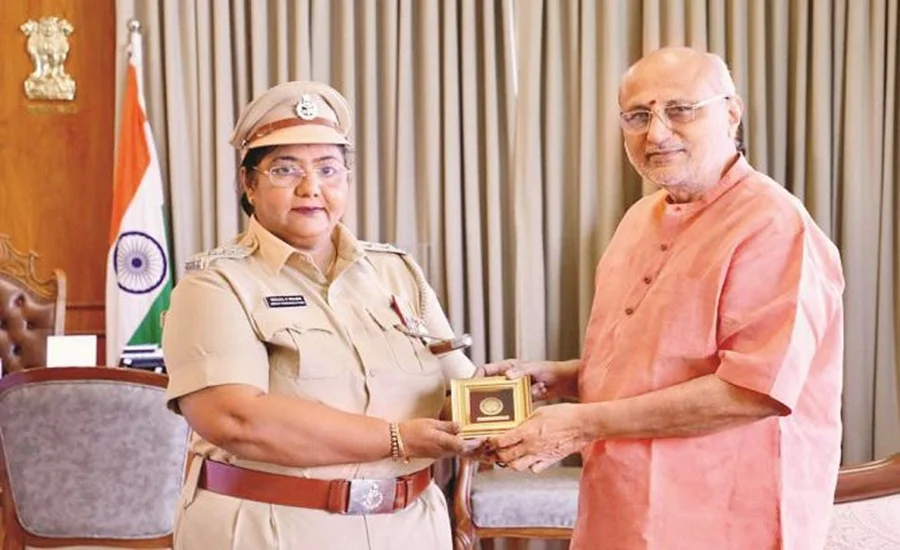
Governor of Maharashtra CP Radhakrishnan honoured ACP Rehana Sheikh on her retirement. She was recognised not just for her long career but also for her contribution to law enforcement and her trailblazing role as the first Muslim woman in the Maharashtra police force.
Speaking to Clarion India, Rehana Sheikh said, “I was the first Muslim woman to become a police officer in Sangli and Maharashtra. When I applied, 25,000 women took the police recruitment exam. Only 25 were selected and I was the only Muslim woman among them.”
Sheikh, who hails from Sangli, said her father served in the military, but no one in her family had worked in the police before. Her dream began when she was a national-level volleyball player. Watching the TV serial Udhan, which showed a woman police officer, inspired her to serve the country.
“A kabaddi player from our neighbourhood had become a sub-inspector. I had job offers from banks, but my volleyball coach asked me, ‘Do you want to be a clerk or an officer?’ That question changed my life,” she recalled.
Despite social challenges and the fact that a police job was not seen favourably at the time, her family stood by her. Rehana’s journey in the force was marked by both professional achievements and personal hardships.
“Shortly after I joined the force, my father passed away. I had to take care of my mother, younger sister and brothers. Then I got married in 1991, but my husband died in an accident in 1993. My son was very young at that time,” she said.
After her husband’s death, she was transferred to Solapur and later promoted and posted in Kolhapur. She remarried in 2004 and continued her service with dedication in various cities and districts of Maharashtra.
Rehana Sheikh worked during some of the most dangerous times in Mumbai’s history. “When I began my career, the underworld was very strong. Crimes were violent — beatings, murders. Now, the nature of crime has changed. We see more cybercrime and online fraud,” she explained.
She played an active role in many high-profile operations. “I was part of the police team during the Lokhandwala shootout. I was also involved in the search at Arun Gawli’s Dagdi Chawl, where we seized weapons. Those were difficult times, and I believe the new generation will find such work challenging.”
She also spoke about being among the first batch of women allowed to work at police stations. “Earlier, women officers were only posted at airports or less active places. We were the first to be allowed to work in police stations.”
Balancing home and duty has never been easy. “My husband and my colleagues supported me. I had the responsibility of my family and later my in-laws, too. But I managed both because of their support and Allah’s grace,” she said.
During her long career, Rehana Sheikh was honoured with nearly 150 awards. But for her, the real success lies in the lives she touched and the message she now wants to spread.
“My message to women is: be educated and join the police force. Serve the society, the nation and the country. Even after retirement, I want to continue working for the betterment of people,” she said with pride.
ACP Rehana Sheikh’s journey from Sangli to the top ranks of Mumbai’s police force is not only inspiring but also a symbol of determination, courage, and service.
source: http://www.clarionindia.net / Clarion India / Home> India> Indian Muslim / by Team Clarion / June 03rd, 2025
“This Too Shall Pass,” a debut poetry collection by Muskan Sufi, a young Kodagu student studying in Mysuru, has earned international recognition after being nominated for the prestigious Indie Authors Award 2025, held in memory of American poet Emily Dickinson. The book is now available for purchase online on Amazon.
Muskan Sufi, a student of English Literature and Psychology at St. Philomena’s College, Mysuru, hails from Virajpet in Kodagu and belongs to the Kodava Muslim community. Her literary achievement has drawn attention not only for its quality but also for the quiet determination that brought her recognition at a young age.
Published by the internationally acclaimed Bookleaf Publication, This Too Shall Pass was born out of Muskan’s participation in the publisher’s “21 Poems in 21 Days” challenge. She surpassed expectations by writing more than 28 poems, which resulted in a 50-page collection of emotionally rich, thought-provoking verse.
Her poems explore themes of pain, healing, nature, death, and the complexities of human emotion. With modern and socially conscious subjects, Muskan’s writing brings to life the inner turbulence of individuals and the beauty of life’s fleeting moments. She uses simple yet powerful language, aiming to connect souls and provide hope to those facing life’s darkest times.
Thousands of poets participate in Bookleaf’s global poetry initiatives, and the top entries are selected for book publication and nomination to the Indie Authors Award. Muskan’s nomination has created a ripple in the English literary community, marking a proud moment for the Kodava Muslim community.
Expressing her joy, Muskan said, “I joined the challenge after coming across the campaign on social media. I’ve always loved writing English poetry, but I never imagined my poems would be published or nominated for such a prestigious award. It’s given me great motivation to pursue more literary work.”
Muskan is the daughter of Duddiyanda H. Sufi and Masuda Sufi, who head the DHS Group of Companies in Virajpet. Her father also serves as the president of the Kodava Muslim Association (KMA).
Muskan’s poetry book, This Too Shall Pass, is now available for purchase on Amazon.
source: http://www.hindustangazette.com / The Hindustan Gazette / Home> News> Latest News / by The Hindustan Gazette / pix:kannada.hindustangazette.com / July 21st, 2025
18 Muslim Women Made It To Lok Sabha Since Independence; 13 Of Them Dynasts: Book
New Delhi :
That women were always under-represented in the Lok Sabha is a known fact, but Muslim women members have been a greater rarity with only 18 making it to the Lower House since independence, according to a new book.
And while dynastic politics may not be conducive for democracy to deepen its roots, it has played a positive part in giving chances to Muslim women, with 13 out of the 18 being from political families.
pix: sapnaonline.com
From royalty to a tea vendor-turned-politician’s wife and from a first lady to a Bengali actress, the 18 Muslim women who treaded the hallowed corridors of power in the Lok Sabha are an eclectic mix, with each of them having an interesting backstory, but one common thread — their path to power was always strewn with struggle and hurdles.
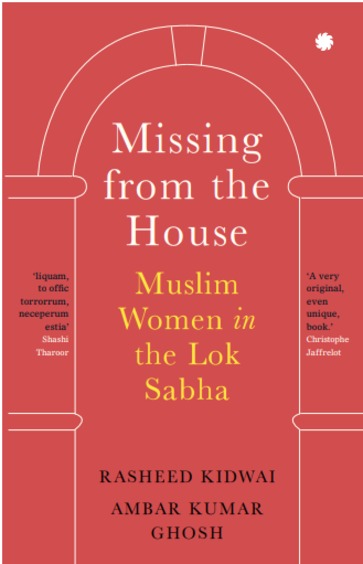
The story of these 18 Muslim women has been chronicled in an upcoming book– ‘Missing from the House — Muslim women in the Lok Sabha’ by Rasheed Kidwai and Ambar Kumar Ghosh. Kidwai says he wanted to document the profile of 20 Muslim women who made it to the Lower House, but two of them — Subhasini Ali and Afrin Ali — had openly proclaimed that they did not follow Islam.
“Only eighteen Muslim women have made it to the Lok Sabha since the first parliamentary polls in 1951-52. It is a shockingly abysmal figure, considering Muslim women are about 7.1 per cent of India’s 146 crore population. Out of the 18 Lok Sabhas constituted till 2025, five times the Lok Sabha did not have a single Muslim woman member,” Kidwai and Ghosh write in their book, published by Juggernaut and will be released next month.
Equally shocking is the fact that the number of Muslim women elected to Parliament in one tenure never crossed the mark of four in the 543-seat lower house of Parliament, the book points out. The book also notes that none of the five southern states — Kerala, Tamil Nadu, Karnataka, Andhra Pradesh and Telangana — otherwise known for better political representation than the North and with better literary levels and other socio-economic indicators, have not yet sent a single Muslim woman MP to the Lok Sabha.
The 18 Muslim women who made it to the Lok Sabha include Mofida Ahmed (1957, Congress); Zohraben Akbarbhai Chavda (Congress, 1962-67); Maimoona Sultan (Congress, 1957-67); Begum Akbar Jehan Abdullah (National Conference, 1977-79, 1984-89); Rashida Haque (Congress 1977-79); Mohsina Kidwai (Congress, 1977-89); Abida Ahmed (Congress, 1981-89); Noor Bano (Congress, 1996, 1999-2004); Rubab Sayda (Samajwadi Party, 2004-09); and Mehbooba Mufti (People’s Democratic Party, 2004-09, 2014-19).
The other Muslim women who entered the Lower House are Tabassum Hasan (Samajwadi Party, Lok Dal, Bahujan Samaj Party 2009-14); Mausam Noor (Trinamool Congress 2009-19); Kaisar Jahan (Bahujan Samaj Party, 2009-14); Mamtaz Sanghamita (Trinamool Congress 2014-19); Sajda Ahmed (Trinamool Congress 2014-24); Ranee Narah (Congress, 1998-2004, 2009-14); Nusrat Jahan Ruhi (Trinamool Congress, 2019-24); and Iqra Hasan (Samajwadi Party, 2024-present).
A dominant political figure who made an indelible mark on Indian politics was Mohsina Kidwai. She not only entered the Lok Sabha but also went on to join the council of ministers and hold several portfolios, including labour, health and family welfare, rural development, transport and urban development.
Another fascinating personality that the book talks about is the wife of Mohammad Jasmir Ansari, a tea vendor-turned-politician. In 2009, Kaisar Jahan, wife of Ansari, won a fiercely fought four-corner contest even though she had barely thirty-five days to prepare and campaign. As 2009 Lok Sabha polls neared, Mayawati summoned MLA Jasmir and Kaisar Jahan to Lucknow. “Jasmir and Kaisar stopped at ‘Sharmaji ki Chai’ in Hazratganj before heading to the chief minister’s residence. Jasmir was anticipating a ministerial position, but instead, Mayawati came straight to the point by asking him to contest the polls. The lingering taste of chai vanished quickly as Jasmir struggled, looking tentatively at his wife for an answer. Mayawati, a politician among politicians, sensed his unease. She directly asked Kaisar: ‘Tu ladegi? The answer came immediately and spontaneously from both Jasmir and Kaisar-yes,” the book narrates.
There is also a first lady among the 18 Muslim women – Begum Abida Ahmed, wife of the country’s fifth president, Fakhruddin Ali Ahmed.
Over four years after Ahmed passed away in 1977, Abida Ahmed agreed to fight a Lok Sabha by-election from Bareilly, Uttar Pradesh, in 1981 and won, becoming the first and only First Lady of India to have entered the competitive arena of politics. She won again in 1984, making it two in a row from Bareilly.
Begum Noor Bano, originally Mahatab Zamani and the widow of the former ruler of Rampur, was royalty who was a key figure in the political landscape of that area and fought many battles with Azam Khan of the Samajwadi Party and Jaya Prada, who also contested on an SP ticket. Her husband, Nawab Syed Zulfikar Ali Khan Bahadur, belonged to the Rohilla dynasty and was popularly addressed as ‘Mickey Mian’. He was killed in a freak road accident in 1992 while returning from New Delhi to Rampur.
Noor Bano won the 1996 and 1999 Lok Sabha polls, but her electoral battles with Jaya Prada in 2004 and 2009 ended in defeats.
Among the 18 Muslim women, Bengali actress Nusrat Jahan Ruhi also broke a number of glass ceilings as she went on to win the Lok Sabha polls on a TMC ticket in 2019.
In the current Lok Sabha, there is just one Muslim woman MP, and that is SP’s Iqra Hasan Choudhury. From earning the distinction of being one of the youngest MPs after defeating a veteran leader from the BJP to becoming the centre of social media discussion as a young, London-educated Muslim woman leader, Iqra Hasan has appeared to have carved out a space for herself in the public imagination.
In his foreword to the book, Congress MP Shashi Tharoor writes, “Nearly seventy-eight years have passed since that portentous stroke of midnight on 15 August 1947, when Pandit Jawaharlal Nehru proclaimed a ‘tryst with destiny’ and India awakened to ‘life and freedom.’ …Yet even after almost eight decades, a shameful reality, which should deflate our self-congratulatory fervour over our democratic track record, still haunts us.”
“Not everyone has found ‘utterance’ in the world’s largest democracy, many of whose towering leaders eulogize it as the ‘Mother of Democracy.’ This self-serving description is enabled, in part, by a too-pliant news media, an ineffectual civil society and a menaced academic class, so that no one dares point out the irony inherent in the claim,” Tharoor says.
“Although we depict India as a doting mother nurturing and nourishing a clamorous, combative and chaotic republic, corrupt and inefficient, perhaps, but nonetheless flourishing, the truth is that throughout our democratic history, we have consistently failed our women citizens: failed to afford them, in the thoroughfares of our country, a life of dignity and decency,” he says. (Agencies)
source: http://www.dailyexcelsior.com / Daily Excelsior.com / Home> Latest News / by DailyExcelsior.com / book pix edited: sapnaonline.com / July 20th, 2025
The Muslim girl from a modest middle-class family in the village’s Waja Mohalla tops Mumbai University with 87% in LLB
New Delhi :
In a proud moment for the Muslim community of Sopara, the ancient port and trade centre of Maharashtra, Benji Mehwish Abdul Rehman has etched her name in the annals of history as the first Muslim woman lawyer from the village. Her remarkable achievement includes topping Mumbai University with an outstanding 87% in the LLB examination is a testament to her relentless hard work and dedication.
Mehwish’s journey is not just about academic success but also about breaking social barriers. Coming from a modest middle-class family — her father, Abdul Rehman, works as an electrician — Mehwish’s path was filled with financial challenges. Yet, these hardships never dimmed her spirit or determination to succeed.
“I belong to the middle class. My father is an electrician, and I was aware of this from the beginning, so I always focused on studying hard. To make a unique identity in the society by working hard, that was my motto,” Mehwish told Clarion India over the phone. She recalled how financial struggles made her educational journey tough, but the unwavering support from her family helped her overcome every obstacle. During this time, many problems came up, but with the help of my family, I faced these problems with a smile. In this journey, my grandfather, grandmother and parents always stood by me like a rock. I secured the first position in every class.”
Her academic record speaks for itself: after passing her SSC in 2015 from Anjuman Khairul Islam Urdu High School, with 84%, she continued to shine with 80% in HSC from RB Harris Junior College and 84% in BCom from AE Kalsekar College in 2021. Clearing the bar examination from Viva College, Virar, with 87% (CGPA 9.2), she secured first position in both Mumbai University and Viva College.
Mehwish’s success carries extra significance as it comes from a community often overlooked and sidelined in mainstream narratives. Sopara, a village with deep historical roots, now celebrates this milestone that challenges the stereotypes around Muslim women and their place in education and professional fields.
Mehwish’s grandfather, Benji Rizwan Muhammad, a respected social activist in the region, played a vital role in guiding and encouraging her career choice. “The decision of which field to choose after graduation was difficult for me because all the courses were very expensive. In such a situation, by the grace of Allah Almighty, my grandfather guided me and encouraged me to become a lawyer,” she said.
She also credits the financial help from the Waja Mohalla Juma Masjid Trust and the Sidha Educational, Social and Cultural Organisation. “If these two trusts had not supported me financially by providing scholarships, this success would have been difficult,” she said gratefully.
Abdul Rehman, Mehwish’s father, expressed his pride: “My daughter is committed to discipline in her studies. We always encouraged her and provided her with whatever we could.” The support from the family, often the backbone for Muslim girls pursuing education, is a reminder that strong family encouragement can overcome societal pressures and economic difficulties.
Local social worker Zubair Ahmed Butke praised Mehwish’s achievement. “Mehwish has increased the glory of Sopara village and our Waja Mohalla by passing the bar exam. She is a role model for our community and shows that with hard work and determination, Muslim girls can reach great heights,” he said.
Mehwish now plans to practice law at Vasai Court and is preparing for her LLM. She also aspires to practice in the Bombay High Court, showing ambition that goes beyond personal success, reflecting a commitment to serve and uplift her community through the legal system.
Her story comes at a time when Indian Muslims, especially women, face various challenges related to education, economic opportunities, and social acceptance. Mehwish’s success is a beacon of hope, breaking through the barriers set by a society where many still hold biases and misunderstandings about Muslims, particularly Muslim women.
Her rise is a clear rebuttal to those who underestimate Indian Muslims or limit their potential by social or religious stereotypes. This achievement demands recognition and respect for the many silent struggles Muslim families endure in supporting their daughters’ education and professional dreams.
Community leaders and activists hope Mehwish’s story will inspire more families in Sopara and beyond to invest in girls’ education and help dismantle the barriers that have held back many Muslim girls. It also raises a call for greater institutional support to provide scholarships and opportunities to deserving students from minority communities.
Mehwish’s journey highlights a broader issue: while India prides itself on secularism and equal opportunity, the lived reality for many Muslims is often marked by discrimination and neglect. Success stories like hers push against this narrative and remind the nation of the rich talent and determination within Muslim communities waiting to be nurtured.
In contrast, some sections of the Hindu majority, especially in surrounding areas, have often failed to create an environment conducive to the educational and professional growth of Muslims. Many Muslim students face discrimination and a lack of resources, making achievements like Mehwish’s even more remarkable.
In conclusion, Mehwish’s story is not just her personal victory but a triumph for the entire Indian Muslim community. It sends a strong message that Muslim girls from modest backgrounds can break social barriers, excel academically, and contribute meaningfully to society when given support and opportunity.
Her rise deserves to be celebrated widely — as a beacon of hope and a clear example that when families and community come together to support girls’ education, the results can be extraordinary.
source: http://www.clarionindia.net / Clarion India / Home>Editor’s Pick> Indian Muslims> Women / by Mohammad bin Ismail / July 14th, 2025
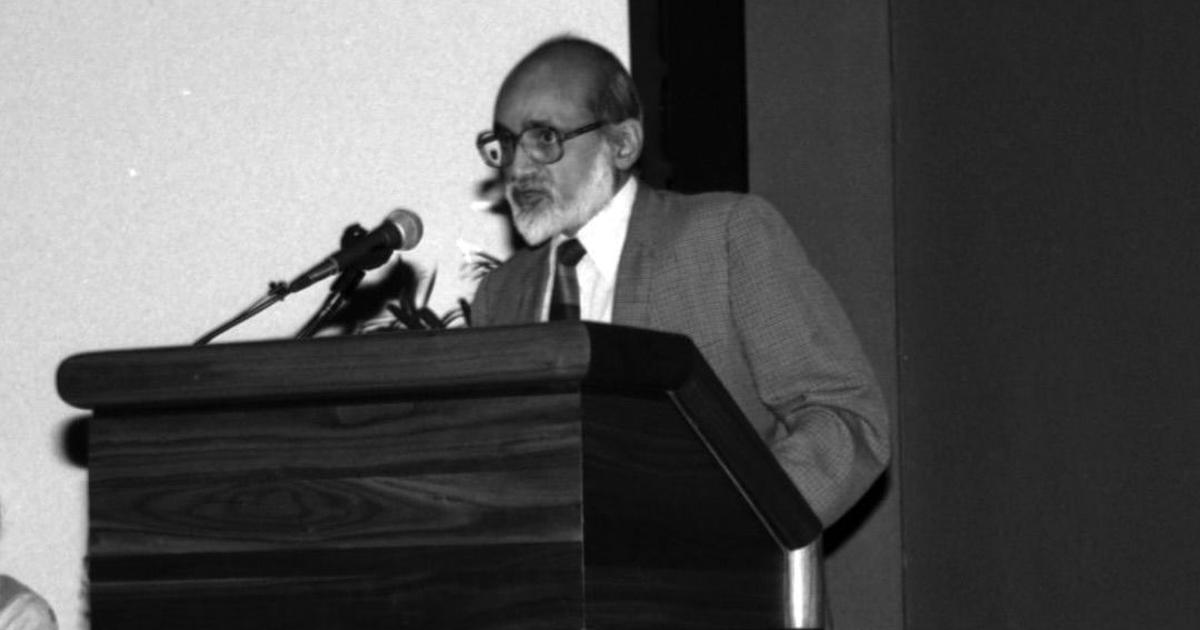
CM Naim’s translation of 19th-century reformer Ashrafunnisa Begum’s biography was published in 2021. Naim, a translator and scholar of Urdu, died on July 9.
Choudhri Mohammed Naim, aka CM Naim, a prominent scholar of Urdu language and literature, died on July 9 at the age of 89. He was a professor emeritus at the University of Chicago.
Naim was also the founding editor of the Annual of Urdu Studies and Mahfil (now Journal of South Asian Literature), as well as the author of the definitive textbook for Urdu pedagogy in English.
He was born on June 3, 1936, in Barabanki, Uttar Pradesh and educated at Lucknow University, Lucknow, Deccan College, Poona, and the University of California, Berkeley. In 1961, he joined the faculty of the Department of South Asian Languages and Civilizations at the University of Chicago, which he chaired from 1985 to 1991. He retired in 2001. He was a national fellow at the Indian Institute of Advanced Study, Shimla, in 2009, and a visiting professor at the Jamia Millia Islamia, New Delhi, in 2003.
Some of his best-known works are Ambiguities of Heritage (1999), Urdu Texts and Contexts (2004), and The Muslim League in Barabanki (2013). He also translated Urdu writings into English some of which are Ghalib’s Lighter Verse (1972), Inspector Matadeen on the Moon: Selected Satires (1994), Curfew in the City (1998), and A Most Noble Life: The Biography of Ashrafunnisa Begum (1840–1903) (2021).
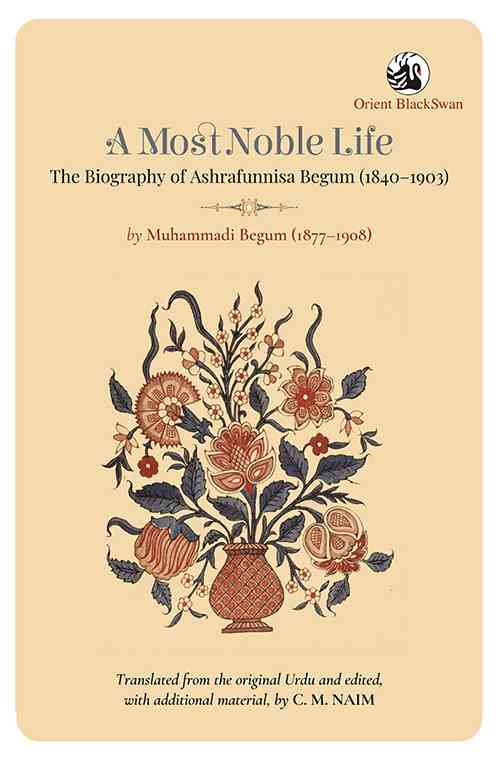
A Most Noble Life: The Biography of Ashrafunnisa Begum (1840–1903)by Muhammadi Begum (1877–1908) is the first complete English translation of Hayat-e Ashraf (1904), the extraordinary story of Ashrafunnisa Begum. Ashrafunnisa, born in a village in Bijnor, Uttar Pradesh, taught herself to read and write in secret, against the wishes of her elders and prevailing norms. She went on to teach and inspire generations of young girls at the Victoria Girls’ School – the first school for girls in Lahore. Her unusual life was written about with great poignancy by Muhammadi Begum – the first woman to edit a journal in Urdu, the weekly Tahzib-i-Niswan. Muhammadi Begum was a prolific writer of fiction and poetry for adults and children, and instructional books for women during her brief life. She aptly titled the biography Hayat-e Ashraf: it echoes the name of her subject, but also means “the noblest life”. Indeed, both biographer and subject may be described, says Professor CM Naim, as “noble lives”.
The two women, who met by chance at a wedding, instantly developed a strong mutual affinity, which grew into a lifelong bond. In Ashrafunnisa Begum, Muhammadi Begum saw not only the mother she had lost as a child, but also an inspiring role model who had led a principled life of her own making, and shown amazing grace and strength against grave odds.
This annotated translation by CM Naim, an eminent scholar of Urdu literature and culture, also provides the first detailed study of the life and works of its author, Muhammadi Begum, and highlights, in an “Afterword”, two key social issues of the time, women’s literacy and widow remarriage, which remain as relevant today.
In this conversation with writer Githa Hariharan (in 2022), CM Naim spoke of the lives and times of Muhammadi Begum and Ashrafunnisa Begum, their work, and the unique friendship that nurtured both of them.
Let me begin with asking you to comment on the ways in which this slim biography of Ashrafunnisa by Muhammadi Begum dispels the gloomy image of the silent and secluded Muslim woman of the 19th and possibly 20th century.
The trouble, as I see it, lies in the “totality” and “exclusivity” we allow to these claims. In the 19th century, a huge number of Muslim men were not literate, just as a huge number of Muslim women were not secluded, or not any more secluded than the non-Muslim women of the same class, occupation or region. The wives of Muslim weavers and barbers and food-sellers may have kept their faces covered while toiling alongside men but their lives were not secluded the way we assume them to be – rightly – for the women of the upper classes. Then there were the differences we see in Bibi Ashraf’s life. Her family was Shi’ah; the women of the household held weekly majlis where they read out texts from religious books. She lost her mother when she was only eight; otherwise, she would have learnt to read and write the way other girls in the family did. We also see a young Muslim widow, a Pathan, taking up employment with the family as a Qur’an instructress.
I found A Most Notable Life a fascinating entry point into the lives of two women I want to know more about. But I also want to know more about the context of their times and work. Ashrafunnisa’s account of how she learnt to read and write is, for me, the most moving section of the book. She encounters obstacles in learning how to read, but the challenges she faces in learning how to write seem far more severe. I am curious about this. Is it far-fetched to conclude that a writing woman presents a greater threat to the patriarchal establishment, because she assumes the power of an “inscriber” rather than merely being a body (or mind) to be inscribed upon?
The chief obstacles are the wilful grandfather and uncle. The grandfather holds the most authority, and the uncle is more immediately present in the lives of the women in the household. The grandfather is not against female literacy in principle. He willingly allows it until the widowed female teacher gets remarried. That is a worse “sin” in his eyes than reading and writing. But then he considers the fact of his son, Bibi Ashraf’s father, taking up a pesha, a profession – he moved to Gwalior and became a lawyer – an equal threat to his honour. The family’s attitude toward writing is complex. Her grandfather tolerated some girls in the family learning writing from their mothers; her father rejoiced when he learned that Bibi Ashraf could read and write so well, but her uncle became more furious and punitive. I feel writing in the upper classes, where seclusion was more closely observed, was seen as an instrument that could make it possible for women to break out of that seclusion. We should not assume that writing was then considered an integral element of education. Transmission of essential or requisite knowledge to a majority of males and females could be done orally. Or so, arguably, the society believed at the time.
I am amazed by the use of multiple genres by both women – poetry, essays, memoir, biography, novels, stories for children, “instruction” manuals. Was this characteristic of the “educated” of the times, or was it driven by the need to be useful to a range of readers? And would you say that in the case of women, or these two women at least, the autobiographical element links all the genres they make use of?
That’s a very interesting question, and I don’t have a clear answer. I can only assert with some confidence that before the 20th century, most prose writings also contained verses. Very often, these were original verses by the author of the text, alongside quoted verses by well-known or obscure poets. The purpose could have been to emphasise a point by reiteration in a more memorable form, or adding the authority of the past to the point being made. The same is done, for instance, by using proverbs. Nazir Ahmad, the reformist novelist, was a great versifier and public orator. His lectures and long poems at the annual sessions of the organisations he supported were hugely popular. So, anyone who learned to read in those days encountered poetry from day one. And if you had creative impulses, you trained yourself to write verses as well as sentences. In the case of Muhammadi Begum, she was indeed driven by a powerful urge to be useful to other women – her sisters, bahneñ – in particular her contemporaries, i.e. young wives, and girls, and wrote in several genres.
Since the education of women is so crucial in the context of the two women’s lives and work, the writing does a balancing act between the creative and the expression of the self on the one hand, and the didactic on the other. To what extent does such didactic literature – or “instructional books” – differ when authored by men (such as Nazir Ahmad, whose work took up women’s education as well as conduct), and women such as Ashrafunnisa and Muhammadi Begum? My friend, writer and critic Aamer Hussein, writes that “Muhammadi Begum reworks and amends, with affection and insight, the reforms suggested by Nazir Ahmad.” In what ways do the women, Muhammadi in particular, take the project forward, not only as writers, but as journalists, teachers and publishers?
What we now label “didactic fiction” was not thought of as merely instructional by its authors; they meant it to entertain too. It would have been Khel khel meñ kam ki bateñ, “useful words in playtime”. The authors simply called them novels. And this applies to female writers and readers too, until they began to learn English.
As for your core question, I can best answer it by exaggerating my response. Nazir Ahmad, Hali and other male reformists wanted to educate women so that they would be good mothers to their children and proficient in managing their homes. Bibi Ashraf and Muhammadi Begum prize these goals too, but they also prize education as a means of mental and spiritual self-improvement. For better self-expression, even. But the most important thing with Muhammadi Begum is that she lays great emphasis on a commonality of sorts, on a sisterhood of peers. She also wishes to make women proficient beyond her kinfolk, and even beyond the threshold of her own home. To that extent, it may be more the aspiration of an upper-class woman. But it also suggests that for her, female literacy was a given. As indeed it was by that time for the salaried middle-class.
It’s clear that propriety is the framework within which these two women, and others like them, have to work to reap some gains. Keeping this in mind, may I ask you to unpack the word “hayat” for us? The biography is called Hayat-e Ashraf, and you have translated it as A Most Noble Life. I am thinking of the difference in English between “respectable” and “noble” when I ask you to explain “hayat” for those of us who do not know Urdu.
“Unpacking” hayat would require explaining what “life” meant to Muhammadi Begum or to an Urdu writer in the 19th century – a tall order. I can only say that Muhammadi Begum seems to have chosen the most apt title for her book. It echoes the title of Altaf Husain Hali’s iconic biography of Sir Syed, Hayat-i-Javaid (An Everlasting Life), published only three years earlier. Hayat-i-Ashraf can be read as “The Life of Ashraf[unnisa Begum]” or as “An Ashraf Life,” i.e. “A Most Noble Life.” Ashraf is the superlative of sharif, and the latter, of course, is a marker of numerous presumed personal attributes, ranging from nobility of birth to modesty in speech and much more. Muhammadi Begum organised her book in a similar manner: first, a chronological account, followed by short sections on what she considered her subject’s exemplary traits or, as she put it, her “Disposition, Habits and Manners.” Throughout the text, she never fails to remind her readers – her “sisters” – to exert themselves and follow Bibi Ashraf’s example.
Pioneers have to be remembered not only for what they did – given their times – but also in connection with their descendants. Would you speculate on the ways in which Muhammadi opened doors for the Urdu women writers who came after her in the 20th century?
Muhammadi Begum was not the first woman poet in Urdu, nor the first fiction writer. She was, however, the first in several other ways. She was the first woman to edit an Urdu journal and to write on many of the issues that were of great concern to women of her community and class. She also wrote “manuals” for women – on writing letters, on managing the household, or on meeting their peers outside the kinship network. In everything she wrote, she made it clear there were no limits to women’s abilities. And most importantly, she made it clear that women can help each other in discovering and putting to use these abilities. I should emphasise one point here. It was her husband’s dream to publish a journal for sharif women that was also edited by a sharif woman – contra the two journals that had appeared earlier and failed. Mumtaz Ali was a champion of Muslim women’s causes, and he strongly believed in gender equality. No doubt he viewed himself as a wise guide, and never hesitated to publish in the journal his own views on some subjects of concern; but what impressed me was his readiness to give space to opposing views, never adopting a patronising or dismissive tone in his responses.
Coming back to your question, Muhammadi Begum’s journal, Tahzib-i-Niswan, gained wide circulation, though subscriptions were slow in coming. But it soon became the journal of choice for aspiring female writers. Hijab Imtiaz Ali, Qurratulain Hyder and Rasheed Jahan made their debut in its pages. And Ismat Chughtai made her first appearance in print as an excited reporter from Aligarh informing the “Tahzib Sisters” that Rasheed Jahan had completed her medical course. So I think it is not so much the matter of opening doors that makes Muhammadi Begum’s journal important; it is the spirit of confident sisterhood that she identified and fostered.
I don’t want the two women, Ashrafunnisa and Muhammadi, to get lost in the jungle of history though, whether it is the history of women’s education or journalism or literature. I want to pay a tribute to their friendship – which allowed them to have a rich relationship that encompasses a role model, a colleague and a surrogate family. And this despite their age difference, despite one being Sunni and the other, Shia. Would you say their friendship gives an edge to their interest in writing memoir and biography?
Their close friendship, their deep trust in each other, was to my mind the most thought-provoking and inspiring thing about them. No doubt, they both had very painful childhoods – having lost their mothers at a tender age. But they also seemed to see in each other a kind of partner-in-arms, joined in some cause. The much older Bibi Ashraf unhesitatingly treated Muhammadi Begum, barely out of her teens, almost as her leader in a cause that concerns all women.
We should also recall that the “seclusion” of sharif women in those days was stricter. It even meant seclusion from the company of a great many females within the extended families as well their neighbourhoods. Muhammadi Begum started her journal Tahzib-i-Niswan in 1898, and amazingly, from the very beginning, she thought of it as a gathering place where women, previously strangers to each other, could meet and become “sisters”. She coined the expression tahzibi bahnen, ‘Tahzibi Sisters’, to describe this coming together. Then, acutely aware of the larger issue, she quickly proceeded to write a manual on the art of Mulaqat, explaining how a sensible woman should behave in the company of other women outside her own family, complete strangers. It was, of course, the time when men in government jobs at all levels, including the salariat middle- and lower-middle class jobs, were liable to be transferred from one district to another, requiring their wives to also move from place to place with them. They led a very lonely life unless they made an effort to know their neighbours – strangers or peers – with no past experience to guide them.
Hamd Foods, a rising name in the natural food products sector, inaugurated its fourth exclusive outlet in Kaup on Thursday, reinforcing its commitment to the brand’s vision, ‘Healthy Food, Healthy Life.’ The launch was spearheaded by Founder Shahida A, Co-founder Mariyam Shahira, and Branch Manager Khairunnisa.
Following the success of its earlier outlets in Falnir, Krishnapura, and Thokkottu, the Kaup branch marks a significant step in the company’s expansion journey. With over 150 natural food and personal care products on offer, the outlet provides customers with options ranging from spice blends, stone-ground pastes, and frozen snacks to flour varieties and skincare items, all free from artificial colours and chemical preservatives.
“In today’s fast-paced world, many people struggle to find time to prepare healthy meals. Through this outlet, we aim to make wholesome, ready-to-use natural products easily accessible to everyone,” said Shahida A, addressing the gathering.
The launch event was attended by several prominent women including Reshma Thota, Prameela Jatanna, Alia Sayyed, and Nilofer Parveen, who expressed their appreciation for the brand’s consistent growth.
“Your consistency and hard work over the past seven years has led you to launch your fourth store today,” noted Reshma Thota. “For working women like us, Hamd’s products are a real support. In a market full of choices, it’s rare to find ones that are both hygienic and chemical-free — Hamd is a brand we truly trust.”
source: http://www.english.varthabharati.in / Vartha Bharati / Home> Karavali / by Vartha Bharati / July 13th, 2025