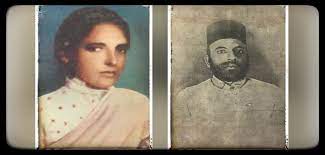
“I appeal to the youth of this country that they sit at the feet of this goddess (Nishat un Nisa Begum) to learn the lessons of independence and perseverance.” Famous Indian writer Brij Narayan Chakbast wrote this in 1918 about the freedom fighter Nishat un Nisa Begum.
People knew more about her husband Maulana Hasrat Mohani, who coined the slogan Inquilab Zindabad (Long live revolution). Historians have kept Nishat, like many other women, at the margins of historical narratives. She existed not as a protagonist but as a supporting actor in a play that had her husband as the protagonist.
This happened even though Hasrat admitted that he would have remained an apolitical editor if he had not married her. Maulana Abul Kalam Azad likened her to “a mountain of determination and patience.” Mahatma Gandhi also acknowledged a key role in the Non-Cooperation Movement. By no stretch of the imagination, she was a dependent woman and owed her existence to Hasrat.
Born in Lucknow in 1885, Nishat was home tutored, as was the custom of those times. She knew Urdu, Arabic, Persian, and English. Even before she married Hasrat in 1901 was teaching girls from backward sections of the society at her home. Marriage exposed her to the world of politics. Nishat and Hasrat were among the first Muslims in India to join Bal Gangadhar Tilak’s extremist group of Congress and open a Swadeshi shop in Aligarh. In 1903, the couple started a nationalist Urdu newspaper ‘Urdu e Mualla’. The British did not like it and jailed Hasrat in 1908. After his release, the couple resumed the newspaper. The newspaper had only two employees – Nishat and Hasrat.
Hasrat was again jailed during the First World War. Nishat, who like other Muslim women of her times, used to take a veil, came out in public to defend her husband in the court trial. She wrote letters to leaders, and articles in newspapers, and removed her veil while visiting courts. To go out of one’s house without a purdah was a courageous act.
Hasrat’s friend Pandit Kishan Parshad Kaul wrote, “She (Nishat) took this courageous step at a time when the veil was a symbol of dignity not only among Muslim women but among Hindu women as well”.
In those times Congress and other organizations used to raise public funds to help the families of jailed freedom fighters. Nishat declined to accept her share from it. Pandit Kishan Parshad recalled later that in 1917 when he once visited her in Aligarh he saw her living in abject poverty. Being a friend of Hasrat, he offered her money. Nishat told him, “I am happy with whatever I have”. She later asked him if he could help her in selling the Urdu books printed by their defunct press.
Kishan Parshad told Shiv Prasad Gupta, another prominent freedom fighter from Lucknow about Nishat’s condition. Gupta didn’t take a moment to write a cheque to purchase all the books from Nishat.
When Edwin Montagu visited India in 1917, Nishat was among the representatives of the All India Women’s Conference (AIWC) to meet him. In the meeting, she demanded that all the freedom fighters be released from jail.
Nishat had abandoned the purdah for good. In 1919, she attended the Amritsar Congress session after the Jallianwala Massacre and impressed everyone with her passionate speeches. A Muslim woman, without purdah and participating in politics at par with her husband, she was noticed as a “comrade of Hasrat.”
Nishat and Hasrat were sure that asking for concessions from the British was futile. They moved a resolution for Purna Swaraj (Complete Independence) and not a dominion status at the Ahmedabad session of Congress in 1921 as the party’s goal. Nishat spoke in support of the motion. The resolution was defeated as Mahatma Gandhi opposed the idea. Eight years later, Congress adopted the Purna Swaraj as its goal.
Hasrat was again jailed in 1922 and this time Nishat attended the Congress Session at Gaya without him. She eloquently opposed the participation of Congress members in the Legislative Councils. She said those who wanted complete independence from British rule could not dream of entering the assemblies formed by them.
According to Prof. Abida Samiuddin, Nishat’s politics did not depend on Hasrat alone. She was the first Muslim woman to address a Congress Session. Her work for the popularisation of Swadeshi, the All India Women Conference, correspondences with the nationalist leaders, articles in newspapers, public speeches, and other political activities are proof that she carried her identity in the Indian Freedom Struggle. She was active in workers’ movements till her death in 1937.
source: http://www.awazthevoice.in / Awaz, The Voice / Home> Stories / by Saquib Salim / May 14th, 2023
Moulvi Allavuddin was sent to cellular jail in Andaman on June 28, 1859.
Moulvi Syed Allavuddin
Moulvi Syed Allavuddin who was a spiritual leader used to exhort the people of Nizam State, one of the strongest princely states of South India, to rebel against the British hegemony. He stood at the forefront of the direct fight against the British Government.
Moulvi Syed Allavuddin was a native of Hyderabad, the capital of the erstwhile Nizam princely state. He intensified his rebellious activities soon after the First war of Independence of India was started in 1857.
A rebellion started in Aurangabad which was part of Nizam State. The rebels who took part in the revolutionary activities in Aurangabad, escaped arrest and came to Hyderabad. They were arrested by the Nizam state police and kept in jail. The people and prominent citizens of Nizam state were angry when Nizam rejected their plea to release the arrested rebels. They met in Mecca Masjid on July 17, 1857, and decided to attack the British Residency in Hyderabad.
That afternoon at 4 pm about five hundred people led by Moulvi Allavuddin and another revolutionary leader Patan Turrebaz Khan marched ahead from Sultan Bazar with war cries to attack the British Residency, a symbol of British Supremacy. Nizam Nawab, being a friend of the British, informed the English officers of the imminent attack. The armies of the English and the Nizam moved strategically and confronted the attackers with additional forces.
Firing continued between the two sides throughout the night. The rebels retreated as the enemy forces gained an upper hand. The angry armies of the British and the Nizam cracked down on the people of Hyderabad. An award of four thousand rupees was announced on the head of Moulvi Syed Allavuddin.
Moulvi went underground. After taking shelter for one and half years from his close friend named Peer Mohammed, he started consultations with freedom fighters and revolutionaries like Syed Bhikkoo, Syed Lal, and Mohammed Ali to put an end to the hegemony of the British on his land and people. At last British forces arrested and sent Moulvi Allavuddin to the cellular jail in Andaman on June 28, 1859.
After leading a miserable life of 25 years as a prisoner, Moulvi Syed Allavuddin passed away in 1884.
source: http://www.siasat.com / The Siasat Daily / Home> News> India / by Syed Naseer Khan / April 03rd, 2023
The first mutiny of World War I was led mostly by young men from villages of Hisar, Rohtak, Meham and Gurgaon districts of Haryana. The Singapore Mutiny, which is known as the first mutiny of WW-I and left an indelible mark on India’s freedom struggle, started on February 15, 1915. It was led by Muslim soldiers who belonged to British army’s 5th Light Infantry Brigade.
Even as the world observes the centenary of the Great War, the sacrifice of these soldiers has been all but forgotten as most of the soldiers and their descendants migrated to Pakistan after Partition.
The brigade mainly comprised Rajput Muslims and Pathans and had been sent from Madras to replace the Yorkshire Light Infantry in Singapore. They reached there in October 1914 and were to leave for Hong Kong in February. On the day of embarkment, a rumour spread that they were actually being sent to Turkey and would have to fight Muslims there.
Singapore Mutiny shook the foundation of British rule in Asia
A rumoured triggered the Singapore revolt. The sepoys killed British officers and seized ammunition. The mutiny went on for 5 days. Eight hundred Indian sepoys of the British army killed 47 British nationals; 200 sepoys faced court martial; 73 were given a range of punishments.
As many as 41 sepoys were shot by a firing squad in front of 15,000 spectators at Outram Prison in Singapore.
In his book “The Mutiny in Singapore”, author Sho Kuwajima has argued that the mutiny not only caught the British off-guard but also shook the foundation of British rule in Singapore and forced the British to reconsider their strategy in Asia.
“The mutiny had a great impact on India’s freedom struggle. Freedom fighters, including Ghadarites were vindicated when finally in 1946, the British decided to leave following the naval revolt of February 19, 1946 when they felt that their protective shield, the armed forces, had itself turned against them,” said historian Malwinder Jit Singh Waraich, who has penned a number of books on the freedom struggle.
Four of those executed in public were from Jamalpur (Hisar), three from Jatusana (Gurgaon) and two from Balyali (Hisar). According to Phul Chand Jain’s Swatantarta Sainik Granth Mala, most of these people belonged to Jamalpur, Paten, Balyali, Kirawad and Balliya Ali in Hisar; Jatusana, Karmpur and Kheri Nangal in Gurgaon; Garhi, Kani and Kahnaur in Rohtak. One sepoy each was from Muzaffarnagar in Uttar Pradesh, Karnal and Nabha in Punjab.
“These villages were gripped by violence of Partition, so, there is not much trace of their memories now,” says documentary filmmaker Daljit Ami, who is making a film on the Singapore Mutiny and has visited these villages a number of times. In the course of his research, he came across just one man who had heard about these heroes and their Haryana connection.
According to historians, the Singapore Mutiny was followed by the Russian soldiers’ mutiny in 1917 and a series of mutinies in the French armies.
source: http://www.timesofindia.indiatimes.com / The Times of India / Home> News> India News / by Sarika Sharma / TNN / July 05th, 2014
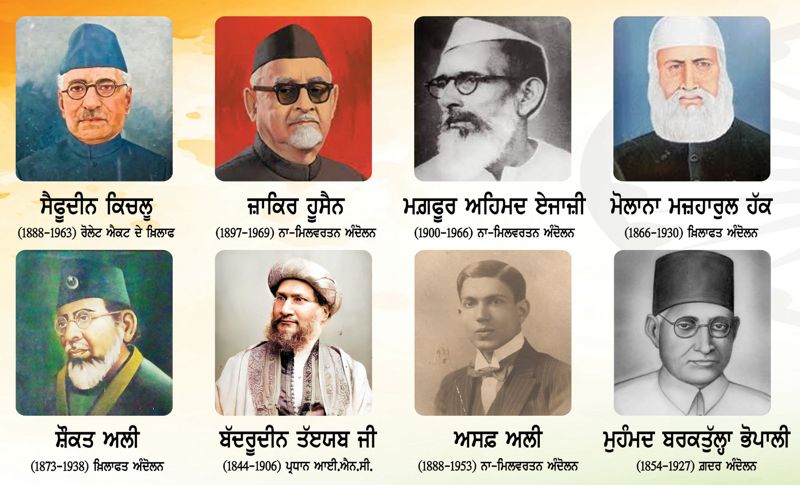
With an intent to highlight the role of Islamic leaders in the pre-independence freedom struggle, a group of Muslim youths have decided to organise a function on the occasion of Republic Day, during which sacrifices of unsung heroes from their community would be highlighted.
Besides organising an elaborate programme after unfurling the Tricolour at the Dehliz Chowk on January 26, the enthusiasts will also install banners displaying portraits of more than 20 prominent Muslim freedom fighters at various locations.
The organisers say the gesture will motivate Muslim youths of the region to come forward and play active in nation building, irrespective of their political, social or religious allegiances.
Zeshan Haidar, the convener of the scheduled event, said youths from various Muslim organisations of the area had been roped in to work in tandem for restoring the lost glory of leaders from their community, who had made supreme sacrifices in struggle against the British Government and played a major role in getting freedom for the country.
“Unfortunately, successive governments have failed to recognise the contributions of Muslim leaders in the freedom struggle and a majority of Muslim freedom fighters and martyrs have remained unsung during functions held to celebrate national events such as Republic Day and Independence Day,” Zeshan Haidar said, adding that these names were also missing from history books.
The enthusiasts have shortlisted names of about 100 Muslim leaders of pre-Independence era and portraits of 20 from them will be displayed in the region.
Maulana Shah Abdul Qadir Ludhianvi (grandfather of Shahi Imam Punjab Maulana Usman Ludhianvi), Zakir Husain, Begum Hazrat Mehal, Maulvi Ahmadullah, Abadi Bano Begam, Ashfaqulla Khan and Husain Ahmed Madni were cited among more prominent Muslim freedom fighters whose portraits figure on the proposed banners.
source: http://www.tribuneindia.com / The Tribune / Home> Ludhiana / by the Correspondent, The Tribune / January 24th, 2023
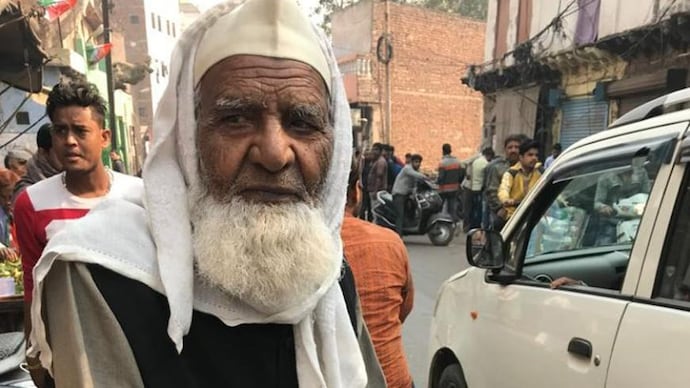
Meet 108-year-old Imamuddin Qureshi who had slapped a British officer during a protest in Agra, only a few days before India got its independence.
Imamuddin Qureshi, the man who had slapped a British officer, during a protest in Agra. (Photo: India Today/Siraj Qureshi)
While Independence was primarily won through the non-violent means adopted and propagated by Mahatma Gandhi, a lot of people had to lay their lives and suffer pain in achieving this. Those fearless freedom fighters were not afraid of sticks or bullets, and defied the British officials at every turn, to show them that Indians have had enough.
One such person is Imamuddin Qureshi, who had even slapped a British officer just days before independence. Imamuddin had fought alone with the British without caring for his life. Whenever the topic of Indian independence is discussed, 108-year-old Imamuddin Qureshi gets lost in the memories of those days when the country became independent.
Imamuddin told India Today that back in August 1947, the country was about to get independence. Everyone was full of enthusiasm. The elders and the children had the tricolor in their hands and happiness in their hearts. People used to take out rallies in the streets, localities, and markets with the Tricolor in their hands. Angered by this, the British officers used to rain batons on them.
He recalled the day he slapped a British officer and said, on August 12, three days ahead of the independence, Hindu and Muslim brothers from Lohamandi, Syedpada area were taking out a rally with the Tricolor in their hands. Then a British officer came there and lathi-charged the people. Many innocent people were arrested. Seeing this, Imamuddin’s blood boiled and he attacked the British officer in anger. He slapped the officer on the cheek several times and escaped after freeing his arrested comrades. The police kept looking for him, but in three days, the country had become independent, and he was able to return home.
Imamuddin said that when the country was nearing independence, he was made a member of the Khaksar committee. At that time, no one dared to speak against the British and members of the Khaksar committee had their own separate dress. He said that at that time, he was about 24 years old and used to do wrestling, so he was made a member of the Khaksar Committee due to his physical prowess.
source: http://www.indiatoday.in / India Today / Home> News> India / by Siraj Qureshi / August 15th, 2022
Hakim Ajmal Khan a philanthropist, freedom fighter, famous hakeem and nationalist is a well known personality.
So I was very surprised when I was told that his grave was I one corner of The Hazrat Rasool numa compound in Panchkuian Road of Delhi
Now it’s a slum
In between a whole row of beds tucked away in one forgotten corner sleeps one of the greatest leaders of our Freedom movement. Revered by Muslims and Hindus alike.
Yes it was Hakim Mohammad Ajmal Khan. I checked up his dated on the net to find they were correct.
The lady who lives there then showed me many graves of Hakeems from his family scattered around the beds and chores of daily life.
Amita Paliwal a Delhi historian and keen heritage lover informs me this is probably the famous Doctor’s lane where Bernier apprenticed to learn Unani medicine.
It may have been famous then but it’s forgotten now and I don’t know why his very rich trust( he had gifted most of his income to charity) and rich family doesn’t do something about it.
You can read more about him below I have taken it from
He was the founder of the Jamia Millia Islamia in Delhi. He is the only person to have been elected President of both the Indian National Congress and the Muslim League, as well as the All India Khilafat Committee.Hakim Ajmal Khan was born in 1863 to the illustrious Sharif Khani family of Delhi, family that traces its lineage to court physicians who served the Mughal emperor Babur, the founder of the Mughal Empire in India.
Khan studied the Qur’an and traditional Islamic knowledge including Arabic and Persian in his childhood, before studying medicine at home, under the tutelage of his relatives. All of whom were well-known physicians.
His grandfather Hakim Sharif Khan sought to promote the practice of Tibb-i-unani or Unani medicine and for this purpose, had setup the Sharif Manzil hospital-cum-college that was known throughout the subcontinent as one of the finest philanthropic Unani hospitals that charged no fees from poor patients.
Once qualified, Hakim Ajmal Khan was appointed chief physician to the Nawab of Rampur in 1892. Soon he met Syed Ahmed Khan and was further appointed a trustee of the Aligarh College, now known as the Aligarh Muslim University.
Hakim Ajmal Khan took much interest in the expansion and development of the indigenous system of medicine, Tibb-i-Yunani, or Unani. Khan’s family established the Tibbiya school in Delhi, in order to expand the research and practice of Unani.
As his family of Hakims served as doctors to the British rulers of India, in his early days Hakim Khan supported the British. He was part of a deputation of Muslims that met the Viceroy of India in Shimla in 1906 and even supported the British during World War I. In fact, the British Government awarded him the titles Haziq-ul-Mulk and Qaiser-e-Hind for his contribution to the expansion of the Unani system of medicine.
But once the British government changed its stance and sought to derecognize the practice of Indian schools of medicine such as Ayurveda and Unani, this turn of events set Hakim Ajmal Khan gathering fellow physicians on one platform to protest against the Raj.
Actually, Hakim Ajmal Khan’s political career commenced with his writing for the Urdu weekly Akmal-ul-Akhbar, which was founded in 1865-70 and run by his family.
Subsequently, when the British clamped down on the freedom movement and arrested many Muslim leaders, Hakim Ajmal Khan solicited Mahatma Gandhi’s assistance and together they joined others to start the Khilafat movement. He was elected the President of the Congress in 1921, and joined other Congress leaders to condemn the Jallianwala Bagh massacre. He was imprisoned for many months by police authorities. Hakim Khan’s pursued his political career side-by-side his medicinal and educational endeavours. Often, the interests overlapped.
Hakim Ajmal Khan resigned from his position at the AMU when he realized that its management would not endorse the Non-Cooperation Movement launched by the Indian National Congress. He envisaged a place of learning that would be free of government control. He worked towards this aim with the help of other Muslim luminaries. Together, they laid the foundations of the Jamia Millia Islamia (Islamic National University) in Aligarh in 1920, in response to Mahatma Gandhi’s call for Indians to boycott government institutions. The JMI subsequently moved to Delhi and slowly grew to be the prestigious university it is today.
Ajmal Khan served as its first Chancellor until his death. He was a key patron of the university, financially bailing it out of sticky situations throughout the rest of his life.
In fact, Hakim Ajmal Khan also established the Tibbia College for higher studies in medicine. Realizing the need for private funding, he simultaneously established a commercial venture the Hindustani Dawakhana to manufacture Unani and Ayurvedic medicines and issued a diktat that doctors practicing in the Sharif Manzil could only recommend medicines from the Dawakhana. The Dawakhana is known to have patented 84 magical herbal formulas.
Tibbia College is presently located Delhi’s Karol Bagh area. As a mark of respect to this man, Karol Bagh’s most popular part is still called Ajmal Khan Road.
Hakim Ajmal Khan died in 1927. In the ensuing years, both the Sharif Manzil and the Dawakhana have languished for want of upkeep and restoration.
Although Hakim Khan renounced his government awards during the freedom movement, Indians who appreciated his work and held him in high esteem conferred upon him the title Masih-ul-Mulk (Healer of the Nation).
Freedom fighter, educationalist and beyond doubt, the greatest contributor to Unani medicine in India in the 20th century: Hakim Ajmal Khan.
Dr. Khan died of heart problems on December 29, 1927. He was succeeded in the position of JMI Chancellor by Dr. Mukhtar Ahmed Ansari.
Rana Safvi is the author of the book “Where Stones Speak”.
source: http://www.twocircles.net / TwoCircles.net / Home> Articles / by Rana Safvi / May 08th, 2016
Bethra Village (Sultanpur District), UTTAR PRADESH :
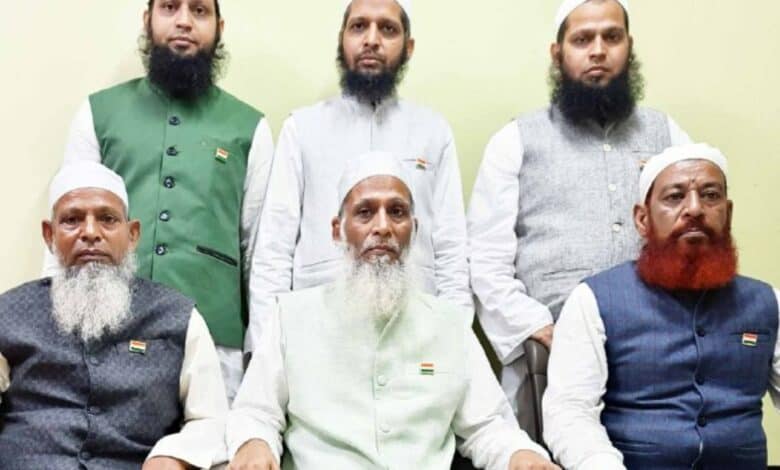
The Surviving kin of Jameel Ahmed Khan, Niayz Ahmed Khan, Nisar Ahmed Khan, Fayyaz Ahmed Khan, Abdul Rehman Khan, Ubaiur Rehman Khan and Wahedur Rehman Khan
British ruled over India, exploiting its people, resources, and wealth. But then there were heroes, the Indian Freedom fighters, who liberated the land through extraordinary acts of courage, valour, and a never-say-die spirit, despite having to make numerous physical, emotional, and personal sacrifices. Some get the limelight, while others remain in the shadows and contribute just as much as the others.
This is the story of one such true freedom fighter, whose tale will inspire you with courage, emotion, and patriotism.
Jameel Ahmed Khan, a resident of Bethra village in the Sultanpur district of Uttar Pradesh, was remembered for his extraordinary contribution and inordinate struggle.
Jameel Ahmed Khan was an ardent, outspoken anti-British activist who was at the forefront of many activities considered against the then British Raj.
This incident demonstrates his patriotism and altruistic behaviour, as when he was sentenced to imprisonment, he discussed the matter with his wife and divorced her so that she could marry someone else, as he was well aware of the uncertainty of his release and the sufferings his wife could face.
When the British Raj Police arrived to arrest him, Jameel Ahmed Khan refused to be handcuffed, declaring, “It is an honour to be a prisoner in the struggle to liberate my homeland, but I will not be handcuffed, and I will go to jail on horseback only because for me this is not a punishment, but a celebration and pleasure.” As a result, he had a horse brought to him and rode it to jail.
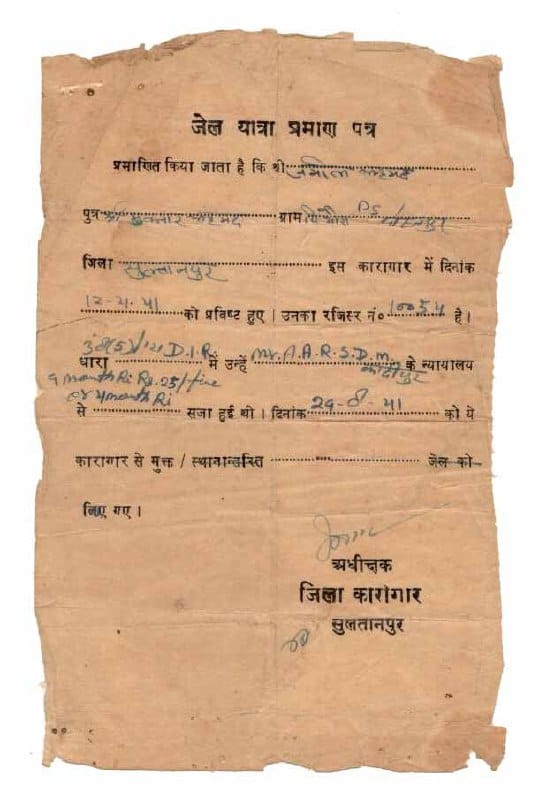
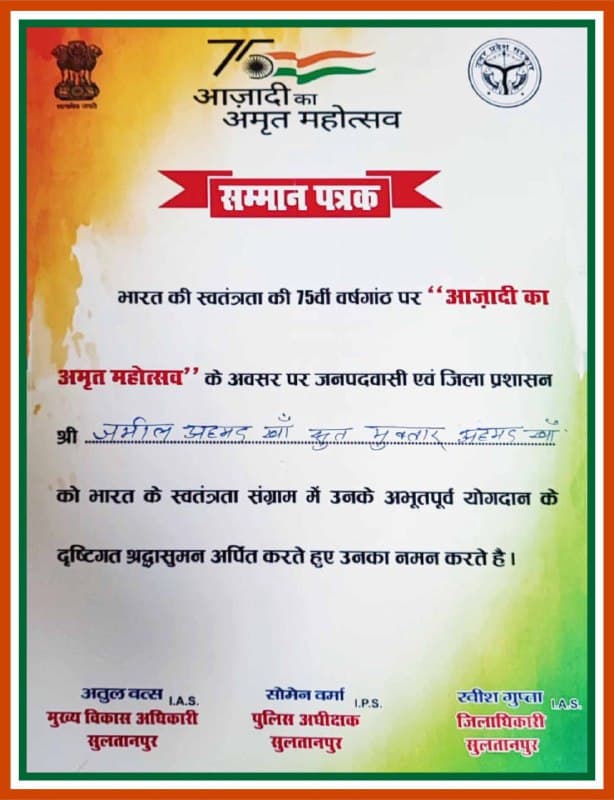
In Bethara, IAS and IPS Sultanpur District visited Jameel Ahmed Khan’s surviving kins and presented them with the Praman Patra in recognition of their ancestors’ contributions.
Shrimati Jabbarunnisa, Jameel Ahmed Khan’s only daughter, has four sons Jalal Ahmed Khan (died in Makkah, Saudi Arabia, in 1984), Niayz Ahmed Khan, Nisar Ahmed Khan, Fayyaz Ahmed Khan and two daughter Razia and Zareena.
Niyaz Ahmed Khan sons, i.e. the fourth generation of freedom fighter Jameel Ahmed Khan are Abdul Rehman Khan, the founder and Chairman of Mumbai’s Bilal School, Ubaiur Rehman Khan, the Founder and Director of Blossom Media Pvt. Ltd. and Abyaz Textile CEO Wahedur Rehman Khan.
The family is pleased that Jameel Ahmed Khan’s contribution is remembered during this historic and significant Indian festival, 75th Azaadi Ka Amrit Mahotsav.
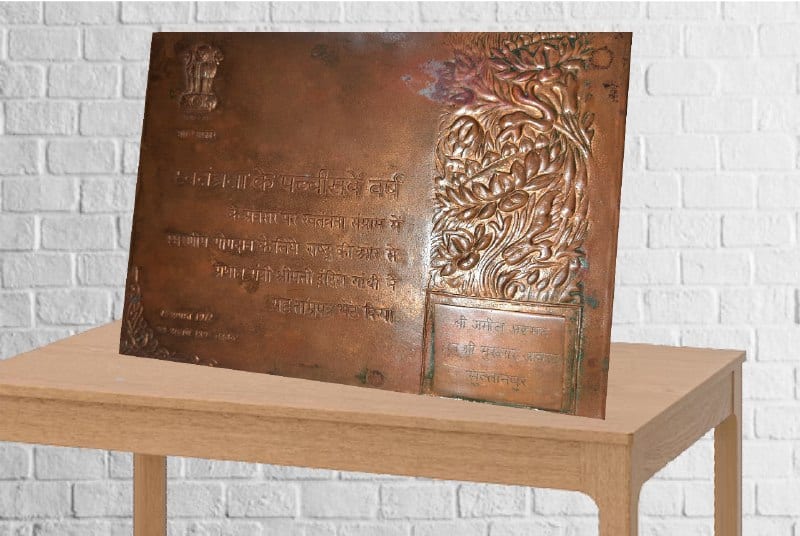
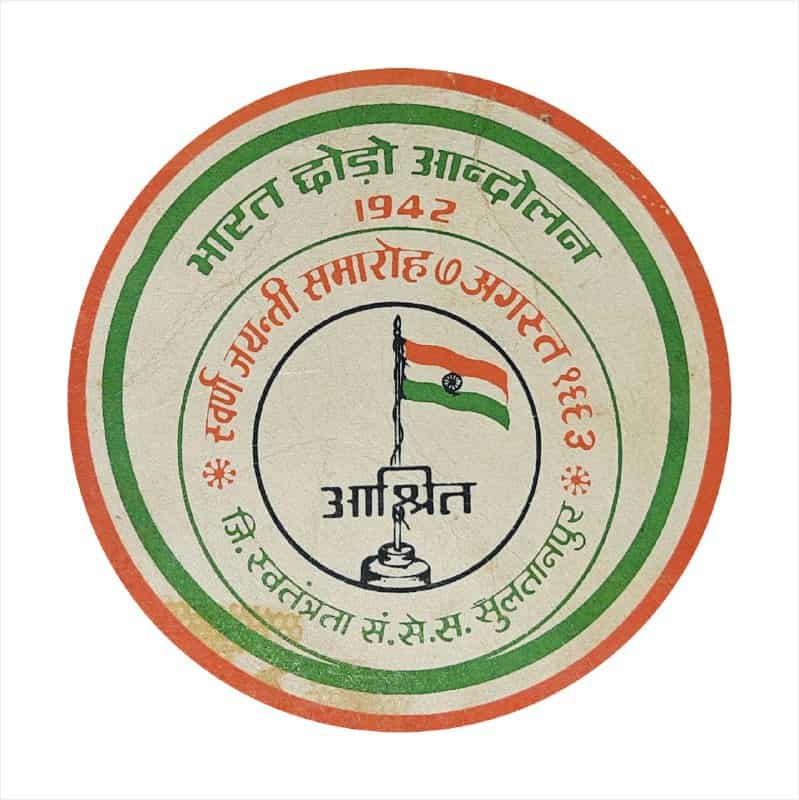
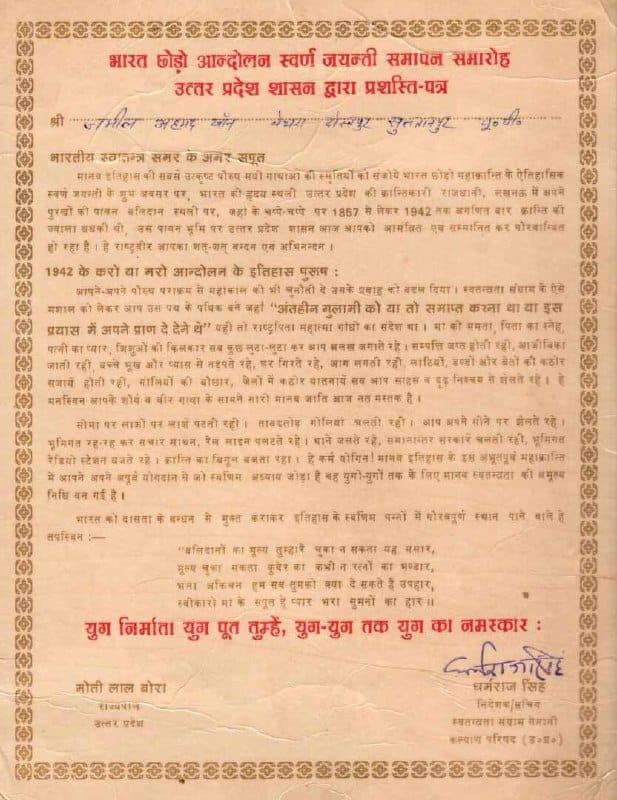
Jail Yatra Certificate issued by Dist. Jail Authority of Sultanpur.Tamr Patra presented to Jameel Ahmad Khan by Prime Minister Shmt. Indra Gandhi on the occasion of 25th Anniversary of Independence on August 15, 1972Badge presented to the kin of Jameel Ahmad Khan by Motilal Vora, the Governor of Uttar Pradesh on the occasion of 50th Anniversary of Independence on August 7, 1993Certificate presented to the kin of Jameel Ahmad Khan by Motilal Vora, the Governor of Uttar Pradesh on the occasion of 50th Anniversary of Independence on August 7, 1993Praman Patra presented to the kin of Jameel Ahmad Khan by Sultanpur Dirtrict Authorities Ravish Gupta (IAS), DM Sultanpur and Soman Varma (IPS) the Superintendent of Police, Sultanpur on the occasion of 50th Anniversary of Independence on August 7, 1993
source: http://www.siasat.com / The Siasat Daily / Home> Opinion / by Neha Khan, Guest Contributor / August 20th, 2022
Indians and other historians have either tried to whitewash the revolutionary movements for freedom or presented these as disjointed localised efforts.
Even the largest movement of Azad Hind Fauj led by Netaji Subhas Chandra Bose has been narrated in a staggered manner and an episodial manner like the battle of Burma (Mayanmar) and the battle of Imphal. The picture thus presented is of an army fighting at a frontier with no support elsewhere. This history needs to be revisited.
In 1930, Sayyid Sibghatullah Shah Al-Rashidi called Pir of Pagaro, a Muslim Saint from Sindh with a huge following, was arrested by the British Government for ‘creating disturbances’. He was accused of instigating anti-colonial feelings among his followers known as ‘Hurs’ (literally meaning free). The decision to send him to a prison away from Sindh rather shaped this anti-colonial Muslim saint into a nationalist revolutionary.
In the Bengal hail, he met several revolutionaries and realised that what he had experienced in his area was the same being experienced by others. He understood that British colonialism was destroying the nation and Hindu-Muslim unity was the only weapon to fight them.
From the prison, he started preaching nationalist messages. Sarah F. D. Ansari of the University of London in her book Sufi Saints and State Power: The Pirs of Sind, 1843 – 1947, writes, “messages strongly coloured with a radical nationalist tinge were smuggled out in the form of notes written in the margins and between the lines of books and magazines. They condemned the British for treating ‘Indians like donkeys’, loading them down with ‘England’s burdens’, and pointed out that the only reason why the British were able to rule over 300,000,000 people was that Indians were ‘cowards’.”
In 1936, when he returned to his seat at Khairpur in Sindh, Pir of Pagaro had turned a revolutionary.
He started establishing links with revolutionary leaders of Bengal as well as those living in Europe, especially Germany. He started inviting Congress leadership to his area and organise Hindu-Muslim unity meetings. We must keep in mind that it was 1938 and Subhas Chandra Bose was the President of Congress. Unsurprisingly when Subhas formed Forward Bloc after his famous differences with Mahatma Gandhi, Pir of Pagaro asked his followers to back Forward Bloc and denounced the stand of Congress.
In 1939, the centuries-old Hindu-Muslim unity of Sindh was severely shattered over the Manzilgah mosque dispute and the riots that followed. Pir of Pagaro ordered his large following of armed followers known as ‘ghazis’ to save Hindus from the Muslim fanatics. Sarah F. D. Ansari writes, “In his newspaper, the Pir-jo-Goth Gazette, he (Pir of Pagaro) called for Hindu-Muslim unity: ‘My forefathers’, he wrote, ‘treated Hindus and Muslims alike as a sacred trust. The same is my principle . .. Allah is the same as Parmatma, though with different names. I will be happy when I see temples and mosques together with only a wall dividing them and everyone [worshipping] according to their rights so that no one may have a grievance against the other’. In a similar vein, he denounced the Hindu Sabha and the Muslim League as divisive communal movements. Only when Hindus and Muslims combined would ‘peace . . . be achieved and satanic deeds . . . stopped’: Indians had to be ‘national minded’ and regard India as a country which belonged to all its inhabitants.”
An intelligence report dated October 1940 says, “Pir of Bharchundi is not liked by the Pir Pagaro, who disrespected the Pir of Bharchundi and sent him away from his ‘Kot’ when the Pir of Bharchundi last visited the Pir Pagaro… the reason for such treatment of the Pir to the Pir of Bharchundi was that the Pir of Bharchundi would not assist in getting the murderers of Hindus arrested.”
It further says, “Pir Pagaro has won great sympathy of the Hindus.” Sarah also points out how the Pir came out in support of a Muslim man’s right, who had earlier converted into Islam from Hinduism, to reconvert into Hinduism. “
Another intelligence report noted that Pir of Pagaro has enlisted at least 6,000 militants to fight with an oath to die for the cause. These militants were called ghazis. Ghazis had paraded and displayed their military skills in front of him during his visits to Jaisalmer and Jodhpur as well. The nationwide presence was a threat for the British. The report further noted, “the Pir was renewing his contacts with terrorists (terrorists was a term used by the English for revolutionaries) who had been in prison along with him in Bengal. His visits to Calcutta (Kolkata) were, it is said, performed for no other reason.”
The British apprehension was not wrong. Pir Pagaro had contacts with Bengali revolutionaries and Subhas. If Subhas raised an army on Eastern Front, Pir of Pagaro raised another on the Western Front. An intelligence report from 1941 noted, “He (Pir of Pagaro) has got his electric plant and radio set at which he and his followers hear Hindustani programs from Germany and then spread the German news in the villages which has a disquieting effect on the local people.” The report also pointed out that “the villainous activities of the Pir and his growing contempt of authority are becoming a byword throughout India”.
Pir of Pagaro was running an independent government in that region of Sindh with the help of his militia. The British Government arrested him in Karachi on the pretext of holding talks with him. His ghazis would not stop and kept attacking the British infrastructure. They were so much feared that the Legislative Assembly members did not want their names to become public for voting in favour of an act against Hurs (followers of Pir of Pagaro).
Sarah notes, “The level of fear which existed in Sind at the time even inside the Legislature was reflected in the session being held in camera. Members of the Assembly were not prepared to vote openly in favour of the act ‘lest they were marked down for the Pir’s future vengeance’.” The fear was not unfounded as soon after Ghazis killed the son of Hidayatullah, one of the tallest Sindh leaders in that Legislative Assembly, by derailing a train.
It did not take much time and within weeks Martial Law was declared. The British had to open a war front at the time of World War II. Sarah writes, “The area north of Sanghar and the Thar desert (Rajasthan) were thoroughly reconnoitered from the air; paratroopers and bombs were used against bands of armed men. Hur villages were raided, wells stopped up and their cattle herded into other districts.” On the other hand, the Pir was being tortured to ask his followers to put down their weapons.
Did the nationalists concede defeat? No. The Pir of Pagaro, Sibghatullah, embraced martyrdom at the gallows on 20 March 1943, after a sham of a court trial. Hurs kept fighting the British till 1946 even after their Pir was gone.
source: http://www.awazthevoice.in / Awaz, The Voice / Home> Culture / by Saquib Alim / July 23rd, 2022
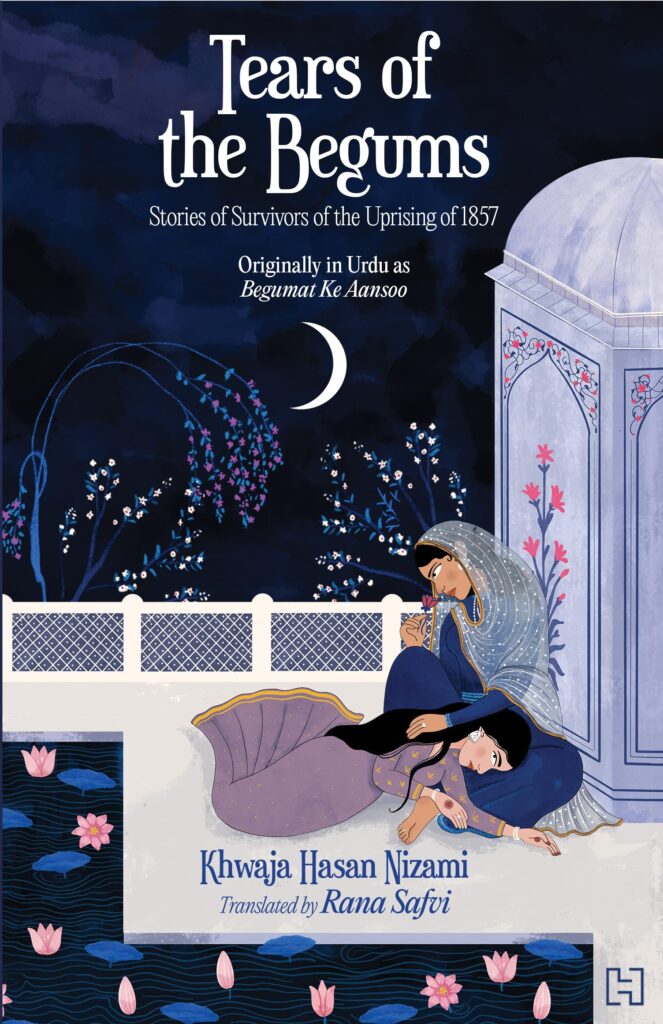
New Book , First ever English translation of Nizami’s invaluable Urdu book Begumat ke Aansoo
pix: amazon.in
Apart from the fifteen years that Sher Shah Suri snatched upon defeating Humayun, the flag of the grand Mughal Empire flew over Delhi undefeated for over 300 years.
But then, 1857 arrived and the mighty sword fell helpless in the face of a mightier British force.
After the fall of Delhi and Emperor Bahadur Shah Zafar’s tragic departure from the Red Fort in 1857, members of the royal Mughal court had to flee to safer places. Driven out from their palaces and palanquins onto the streets in search of food and shelter, the dethroned royals scrambled to survive. Some bore their fate with a bitter pride, others succumbed to the adversity.
Through twenty-nine accounts of the survivors of the Uprising of 1857, Khwaja Hasan Nizami documents the devastating tale of the erstwhile glorious royalty’s struggle with the hardships thrust upon them by a ruthless new enemy.
In vivid and tragic stories drawn from the recollection of true events, Nizami paints a picture of a crumbling historical era and another charging forward to take its place.
With the reminiscence of past glory contrasted against the drudgery of everyday survival, Tears of the Begums – the first ever English translation of Nizami’s invaluable Urdu book Begumat ke Aansoo – chronicles the turning of the wheel of fortune in the aftermath of India’s first war of independence.
source: http://www.amazon.in / Amazon / Home> Books> History> World / as on August 06th, 2022
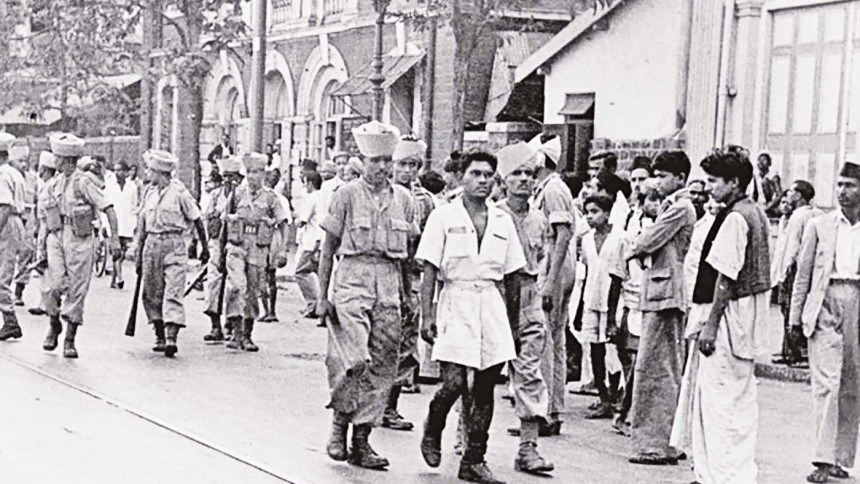
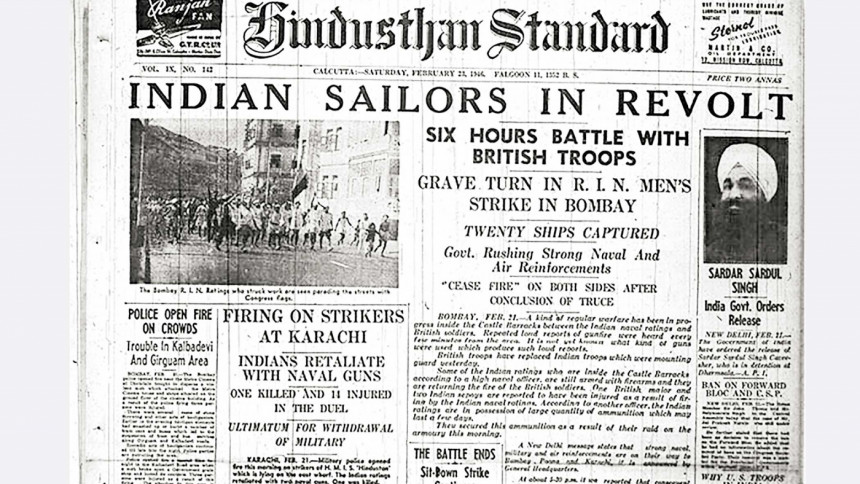
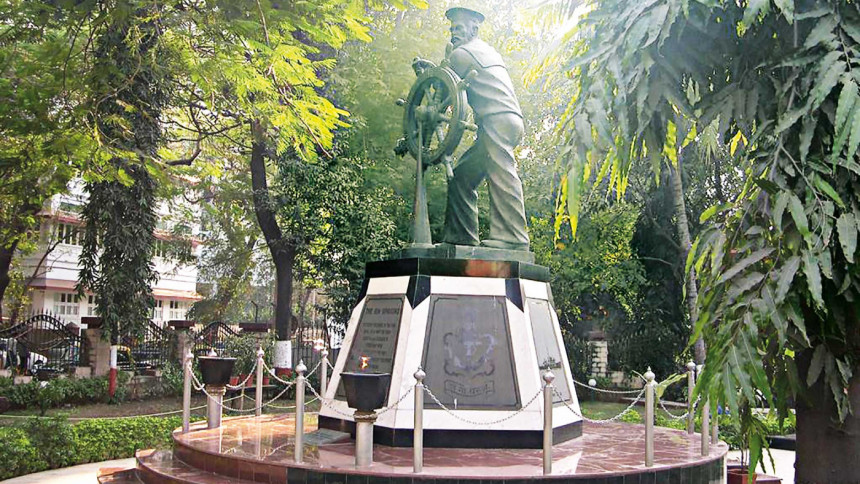
One of the most important but undervalued events of India’s independence movement was the naval revolt of 1946, about which Indian historian Sumit Sarker wrote, “Had this insurrection succeeded, India’s struggle for freedom might have taken a different turn.” From February 18 to 23 that year, more than 20,000 ordinary sailors, known as ratings, and low-ranking officers of 74 warships and 20 installations took part in a strike, which was termed as a mutiny or rebellion.
After Bengal lost its independence at Palashi’s Mango grove in 1757, the British Raj in India faced two major armed revolts: the first one was exactly after one hundred years, the military revolt of 1857, and the second one was 189 years later, the naval mutiny. Both in 1757 and 1857, the freedom fighters were defeated by the arms and tactics of the British rulers, but the naval mutiny failed because of the politicians in India then. It was not only the ratings’ mutiny that the political leadership had decided not to support – the civilian uprising triggered by the naval mutiny, too, was condemned by them. The scale of the civilian uprising, if it happened in a post-colonial era, would have created a revolution or at least caused the fall of the government of the day.
Three days after the mutiny ended and the civilian uprising was crushed with brutal force, the then British Prime Minister Clement Atlee told the House of Commons on February 26, 1946, “I regret to inform the House that grievous loss of life, injury and destruction of property have resulted from all these disturbances. In Bombay, there have been 223 deaths and 1,037 persons have been injured. The total damage includes the looting or destruction of nine banks, 32 government grain and cloth shops which the public can ill-afford to lose, 30 other shops, 10 post offices, 10 police stations and 1,200 street lamps. The number of vehicles destroyed is not yet estimated. In Karachi, there have been seven deaths and 21 cases of injury. In Madras, up to last night, one person has been killed and another seriously injured” (Source: Hansard).
Mr Atlee in his statement said, “Both Congress and Muslim League leaders cooperated in condemning and attempting to stop the disturbances, but the Communist Party issued a manifesto at midnight on Thursday thanking the public for its support.” It perhaps explains why, to this day, the political classes of the three countries born from the partition of India are not willing to admit their failure and give those mutineers and civilian martyrs their due credit. Therefore, in 2021, there was no big event in the subcontinent to mark the 75th anniversary of the naval revolt.
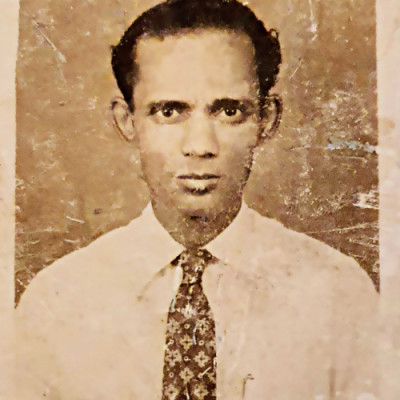
Mohammad Dewan Ali Nazir, Royal Indian Navy, Index no: 34499.
On a personal level, it’s ironic that, despite studying history at the country’s two top universities, I, too, did not take much interest in it during my student life. When I first heard of the rebellion from a mutineer, I had already taken a job and started my professional journey devoid of in-depth history. The mutineer I am talking about was my father, who spoke about his role and feelings about the lost cause during one of my short home visits. My father, Mohammad Dewan Ali Nazir (Royal Indian Navy, RIN, Index no: 34499) was one of the last 3,500 sailors and 300 sepoys who refused to surrender until the last on board of HMIS Akbar.
They were detained after surrendering and were released in August of that year. The mediation and the assurances given by the leaders of both Congress and Muslim League turned out to be nothing but betrayal. Though the uprising was a challenge to the Empire, shaking up the British imperial order, the leaders of the nationalist movement waiting to form an interim government through negotiations were not ready to derail that prospect.
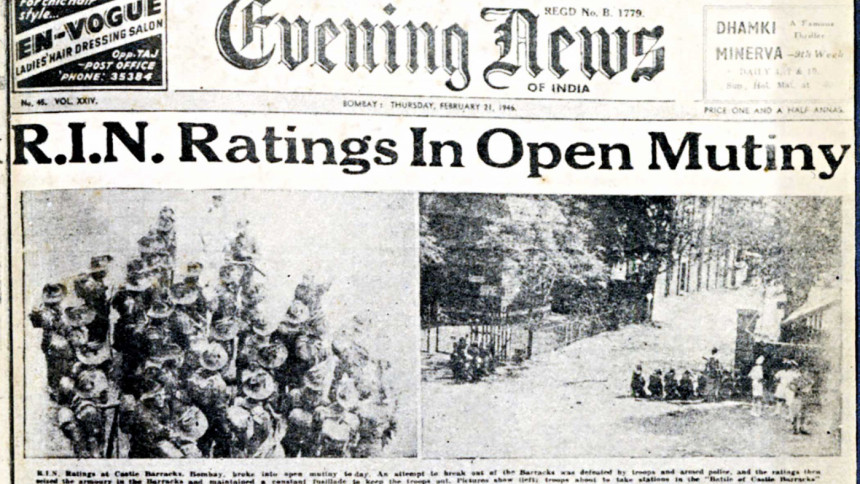
Newspaper clipping of the Evening News.
The leaders of the Congress and the Muslim League did not want a revolution – they wanted a peaceful transfer of power. Among the leading politicians, only Congress leader Aruna Asaf Ali extended her support to the ratings’ strike and tried to persuade her party leaders to take a stand in favour of the strikers, but failed in the face of opposition from Vallabhbhai Patel. On February 22, Vallabhbhai Patel sent a message to the rebels to surrender. Only the Communist Party of India came forward in support of the naval revolt and called a general strike. Reading the memoir of one of the key figures of the revolt, Balai Chand Dutt (BC Dutt), and a few other publications, one can easily imagine how much frustration and pain those mutineers felt because of the national leaders’ silence, which they saw as a betrayal. Perhaps it explains why my father, too, lost interest in politics and didn’t speak much about the heroic uprising that ended in a tragedy.
Those nationalist leaders, including Gandhi, Jawaharlal Nehru and Muhammad Ali Jinnah, advised them “not to mix up ‘political demands along with service demands’; to ‘remain calm’ and to formulate to the naval authorities their service demands.”
But from the very beginning, those naval ratings were raising political demands – particularly, the Quit India slogan.
Their Charter of Demands asked for: 1. Release of all Indian political prisoners; 2. Release of all Indian National Army personnel unconditionally; 3. Withdrawal of all Indian troops from Indonesia and Egypt; 4. British nationals to leave India; 5. Actions against the commanding officer and signal bosonshead for rough treatment of the crew; 6. Release of all detainees (naval ratings); 7. Speedy demobilisation of the RIN ratings and officers; 8. Equal status with the British navy regarding pay, family allowances and other facilities; 9. Best class of Indian food; 10. No return of clothing kit after discharge from service; 11. Better treatment from officers to subordinates; and 12. Installation of Indian officers and supervisors. (Source: Meanings of Failed Action: A reassessment of the 1946 Royal Indian Navy uprising by Dr Valentina Vitali, University of East London, UK.)
Autobiographies of two rebels – BC Dutt and Biswanath Bose – suggest that the then (undivided) India could have been a different place if the revolt of that day had succeeded. The rise of communal politics, the division and instability that is spreading in the states and society, would not have happened.
BC Dutt was one of the organisers of the HMIS Talwar, the ship where the mutiny started. He was arrested and tried for writing a new slogan on a ship on February 1, three weeks before the start of the February 18 mutiny. His book, The Mutiny of the Innocents, contains details of how political literature and pro-independence activities were organised much before their strike.
Biswanath Bose’s RIN Mutiny, 1946 also gives detailed descriptions of how the revolt unfolded. But politicians argued that the revolt was mostly due to the resentment among Indian ratings over low wages, poor quality of food and housing, which was lower than that of the Whites, and racial discrimination.
After the mutiny of 1857, the British rulers banned the entry and discussion of political leaflets in all forces, but BC Dutt used to secretly discuss political documents in the ship HMIS Talwar. Two months before the mutiny, on the Naval Day on December 1, when it was open for public visit, they wrote various slogans, including “Quit India” and “Jai Hind” on the ship. Explaining the reason why the mutiny failed, BC Dutt wrote that while all Europeans and Indians were stunned by the course of events and wondering if it was a revolt, unfortunately the political parties had nothing to say. When it was time to lower the British Union Jack and fly the Indian flag, they felt unprepared.
Newspaper clipping of the Hindusthan Standard
On February 22, 1946, when the nationalist leaders were busy arranging the ratings’ surrender, Prime Minister Clement Attlee told the parliament that the sailors had given political slogans and demanded that a political leader be given a chance to speak. He also said in the statement that Congress had nothing to do with the insurgency, but the communists and leftists could try to exploit sympathy.
William Richardson, a British researcher, writes in The Society for Nautical Research that the political movement for India’s independence was at the root of the revolt (The Mutiny of the Royal Indian Navy at Bombay in February 1946, May 1993).
Author of the book 1946: The Unknown Mutiny, Promod Kapoor wrote that the navies fell between the two aspirations of the two rulers. One side wanted their impending departure not to be tarnished by the stigma of rebellion. On the other hand, when power was imminent, the other rulers were anxious to see if there were any signs of chaos in the armed forces. Because in the future, they would have to manage these forces.
Politicians assured that no one would be punished, no compensation would be paid, and steps would be taken to meet the demands. In reality, the opposite had happened. Rebel leaders were arrested, tried and punished. Other rebels were told to grab third-class train tickets to return home and to never return to Bombay again. Showing various excuses, deductions were made from salary arrears even for minor damages in their uniforms.
Biswanath Bose’s book gives a glimpse of how frustrated and angry these rebels became with the behaviour of the government and the breach of promises by the political leaders. He wrote, “If patriotism is a crime, then we must be criminals.” Expressing his frustration for not being reemployed in the Indian Navy, he wrote a letter to Prime Minister Nehru asking if there was any law banning his return to the force due to dismissal for taking part in the freedom movement, and how, as a leader of the Congress, Nehru could be the prime minister.
Nationalist leaders were so reluctant to give the mutineers their due credit, that the Indian government banned the Bangla play Kallol (Sound of the Wave), based on the mutiny, by playwright Utpal Dutt, and he was imprisoned. The play was first performed in 1965 in Calcutta at the Minerva Theatre and it drew large crowds.
At the beginning of the naval strike, a Central Strike Committee (NCSC) was formed by the representatives of the ships stationed in Bombay. The committee renamed the Royal Indian Navy as The Indian National Navy. The committee was chaired by Signalman MS Khan, and Madan Singh was the vice-president. One remarkable element of the naval rebellion was the unity of various faiths among both the naval force and the civilians who took to the street. They raised slogans “Hindu-Muslim unite” and “Inquilab Zindabad” on the streets of Bombay.
BC Dutt’s book also speaks of this communal harmony. He wrote, “We are from different regions, and from families of Hindu, Muslim, Christian and Buddhist, but after spending years in the Navy, we sailors have become Indians. The irony is that the politics of communal division and hatred is now intensifying across the subcontinent.
(After leaving the job of a naval instructor, my father joined the office of Indian Civil Supply, and after a short stay in Kolkata, he was transferred to East Bengal. He retired as a magistrate and died on August 29, 2001.)
Kamal Ahmed is an independent journalist and writes from London, UK. His Twitter handle is @ahmedka1
source: http://www.thedailystar.net / The Daily Star / Home> In Focus / by Kamal Ahmed / July 25th, 2022


.webp)