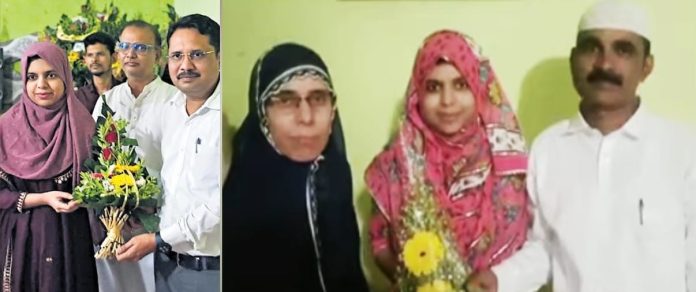
Do it again and again. Consistency makes the raindrops create holes in the rock. Whatever is difficult can be done easily with regular attendance, attention, and action. Perhaps imbibed by the words of Israelmore Ayivor, an inspirational writer, blogger and LifeSkills Entrepreneur, Adeeba Anam Ashfaque Ahmed from Yavatmal in Maharashtra created a record of sorts to become the first female Muslim IAS officer after successfully clearing the civil services with All India Rank 142.
The success saga of Adeeba only proves the awareness shown by Muslim girls to take up civil services exams breaking the barriers.
On cloud nine are Adeeba’s parents, relatives, friends and more particularly her teachers on seeing her victory after three failures. She came out with flying colours in her fourth attempt after getting the necessary guidance and coaching from Jamia Millia Residential Coaching Academy in Delhi.
Can’t imagine a girl hailing from a parched and drought-prone Yavatmal district bringing glory to her native. All because of her patience and consistency as to the quote of American business honcho Robert Kiyosaki – “Successful people don’t fear failure but understand that it’s necessary to learn and grow from.” It is learnt that Maharashtra hardly witnessed any female Muslim IAS officers in the last one decade or so.
Kudos to her dad Ashfaq Ahmed, an auto driver, who despite financial constraints strained his nerves to make his daughter’s civil service dream a reality. Of course, her mom and uncle were very supportive in ensuring she achieved her IAS after successive failures. Adeeba started her early education at Zafarnagar Zilla Parishad Urdu Primary School, where she studied from Class 1 to Class 7. Thereafter, she finished schooling from Class 8 to 10 at Zilla Parishad Government Girls High School. And she completed her 11th and 12th grades at Zilla Parishad Ex-Government College in Yavatmal.
Armed with BSc Mathematics from Inamdar Senior College in Pune, she joined a coaching academy in Pune to take UPSC foundation classes based on the advice of her maternal uncle Jan Nizamuddin Sahib, who works as secretary at Seva NGO.
She got interested after meeting a few IAS officers and was determined to become an IAS. The road to civil services wasn’t smooth for her as she faced many obstacles. However, she was firm and worked relentlessly to taste success.
Noteworthy to mention that her dad Ashfaq Ahmed dropped out of school after tenth standard due to family circumstances. But decided not to let her daughter face the same fate, left no stone unturned and encouraged Adeeba to do her UG. Right from her school days, she had a fascination for civil services inspired by the young IAS officers’ remarkable feat through newspapers. Since then, she has been working towards her civil service dream.
In an interview to a local television channel, she is reported to have said that studying isn’t easy, especially for girls in patriarchal communities like Muslim, but her parents stood by her. She expressed her gratitude to mom, who extended support for her in her endeavours. The community was against girls pursuing higher studies, but her dad told her not to worry about society, and focus on her goal.
It is interesting to infer that she chose Urdu Literature as her optional subject despite having a science background. However, she displayed her prowess in clearing the civil services with confidence. A total of 32 candidates from Jamia Millia Islamia and 3 from Aligarh Muslim University (AMU) Residential Coaching Academy (RCA) have figured in the UPSC Civil Services 2024 Merit List. Of the 1009 candidates selected, only two Muslim candidates figured in the top 100.
She said that IAS is the first step to serve the society and added that her area of interest is to work for the underprivileged, more specifically girls. And she wanted to contribute to the education and health sector as a civil servant. Jamia Millia Islamia (JMI) and Aligarh Muslim University (AMU) RCAs are renowned academies in the field of coaching students for Civil Services. They provide free coaching and training for preparing for the Civil Services Examination for candidates from SC, ST, Women, and Minority communities.
source: http://www.radiancenews.com / Radiance News / Home> Focus> Markers of Excellence / by M Rafi Ahmed, Radiance News Bureau / April 28th, 2025
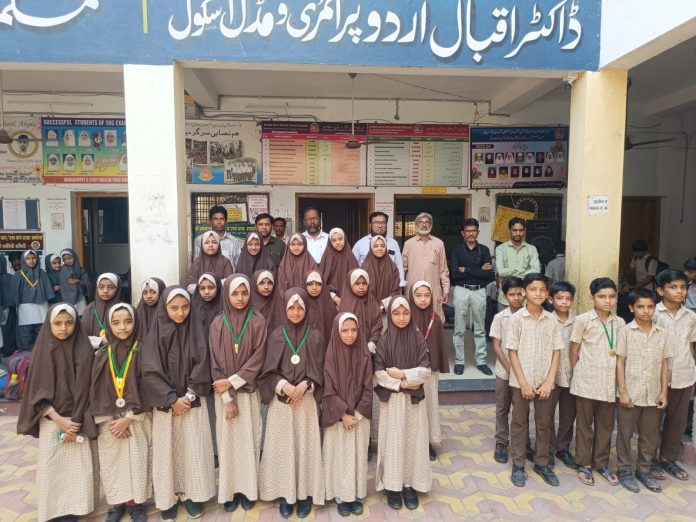
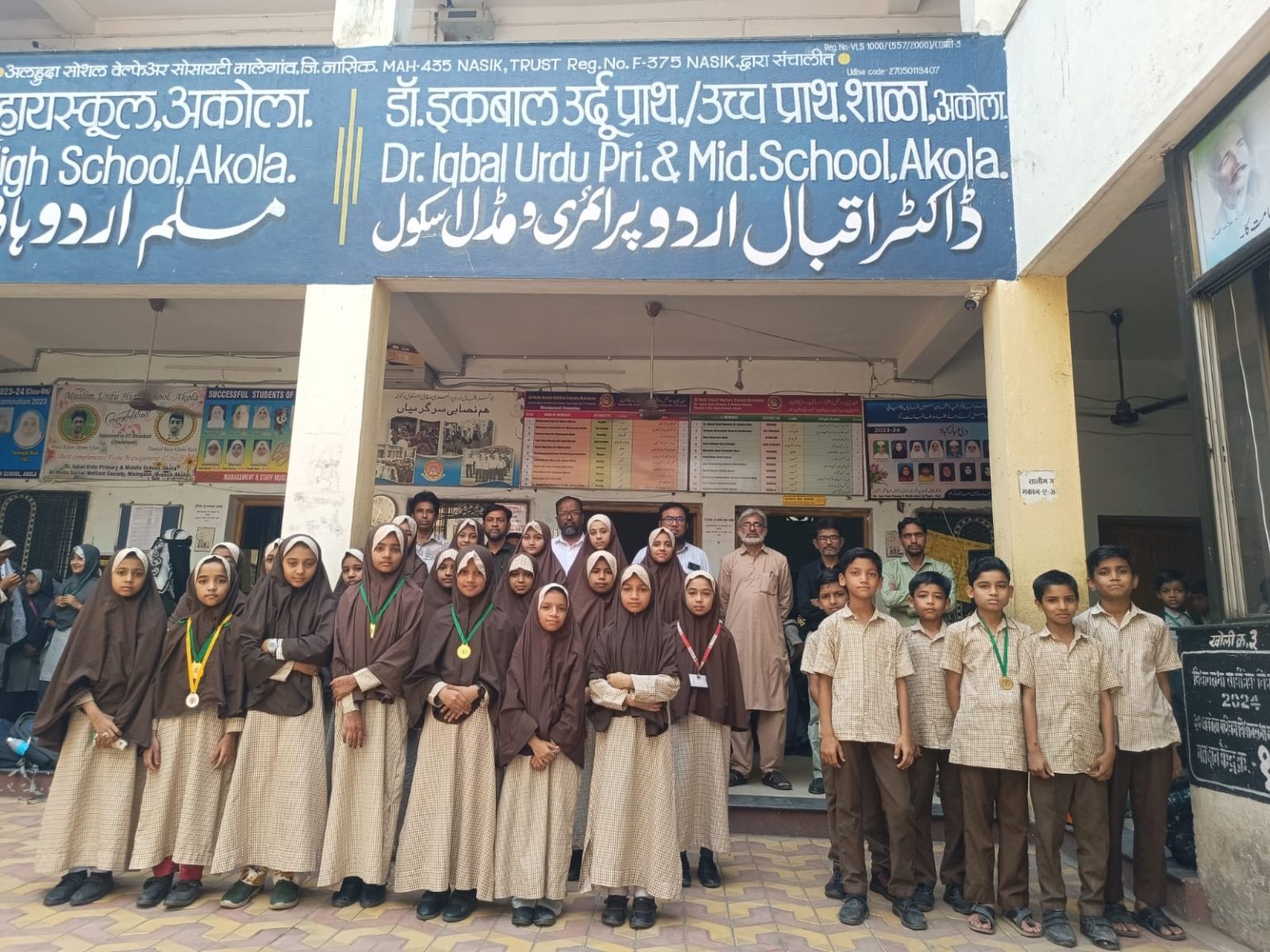
Every year, the Government of Maharashtra conducts a scholarship examination for students of Grade 5, in which lakhs of students from across the state participate. Recently, interim results of this exam were announced. In this examination, 48 students from Dr. Iqbal Urdu Primary School – a renowned and quality institution run by Al-Huda Social Welfare Society, Malegaon, District Nashik – participated. Out of these, 31 students achieved outstanding success.
Hafsa Saman Mohammad Mujahid secured 212 marks out of 300. Fatima Sitwat Azhar Hussain and Zobia Anam Mohammad Mujahid both secured 188 marks respectively, while Sheikh Umar Sheikh Sabir obtained 186 marks.
The school administration always strives not only to encourage students to participate in competitive exams but also to ensure their thorough preparation. For this purpose, the school arranges special classes throughout the year specifically for scholarship students, providing them with extensive practice.
Behind this success lies the significant role of competent and dedicated teachers. The school has expert teachers for this competitive scholarship activity, and the Headmaster is always ready to guide the students. In addition, the parents extended full support.
The institution’s President Dr. Ahmed Urooj, Vice President Khwaja Nizamuddin, Secretary Riyaz Khan, Headmaster Mohammad Ateeque ur Rahman, and the school staff congratulated the students and their parents and expressed their best wishes for great success in the future.
source: http://www.radiancenews.com / Radiance News / Home> Education> Latest News / by Radiance News Bureau / April 26th, 2025
The Rampur Nawabi family with former Prime Minister Dr. Manmohan Singh
In December 2021, I came across a report in a newspaper that said, “After almost 50 years of legal battle, the Rampur District Court has ruled in the Rampur Nawab family’s property dispute. The property will now be divided among 16 legal heirs. Raza Ali Khan, the last Nawab of Rampur, died in 1966. After a long legal battle, the court has announced the division of his property worth Rs 2,664 crore.”
The Nawab family of Rampur with its glorious history is still important played in Rampur and its surrounding districts. While the family ruled the state for a long time, its members joined the institutions of independent India like Parliament and legislative Assembly. Former Members of Parliament Mickey Mian and Noor Begum belong to the family. Many members of this Royal family have played an important role not only in politics but also in promoting the culture, patronizing poets, writers, musicians, and other creative artists.
Khandaan
The Nawabi family of Rampur State
Before the independence, India was dotted with small states and one of them happened to be the state of Rampur, located in today’s state of Uttar Pradesh. It was founded by Nawab Ali Mohammad Khan, a Pushtun leader on 7 October 1774. There have been 11 Nawabs in the state including Nawab Faizullah Khan, Nawab Hafiz Rehmat Khan Barish, Nawab Muhammad Ali Khan, Nawab Ghulam Muhammad Khan, Nawab Ahmad Ali Khan, Nawab Muhammad Saeed Khan, Nawab Yusuf Ali Khan, Nawab Club Ali Khan. Nawab Muhammad Mushtaq Ali Khan, Nawab Hamid Ali Khan.
Raza Ali Khan was the last Nawab of Rampur. Rampur was one of the important States of the British in India as its rulers were plaint and supported the Raj even during the 1857 revolt. It was a 15 cannons gun salute State and its rulers owned a lot of wealth.
Before the independence, the Nawabs of Rampur used to have their own railway station with two special coaches always in readiness in the service of the Royal family. Whenever the Nawab family had to travel by train to Delhi, Lucknow, or elsewhere, they would board their coach and that was added to the passenger train. During the tenure of the ninth Nawab, Hamid Ali Khan the railway line was laid in the district. At that time, he had built a separate railway station for his use. It was close to the main railway station.
The Royal Coach full of Luxuries and modern appliance
Interestingly the two railway coaches that have immense historic and antique value today are among the assets sought to be distributed among the progeny of the Raza Ali Khan. These were originally valued at Rs. 117.42 million. However, due to almost no maintenance, the price was halved.
Interestingly, these coaches had so many modern conveniences that even the heads of the state today can’t dream of. The coaches were equipped with 33mm and 16mm cinema projectors, cameras, imported radio transistors, and tape recorders. These provided all the luxuries like Bedding, chair, carburetor pillow, seat, silverware, glass, whiskey, beer bottles, English crockery, large cigarette and cigar box, silver footstep, eagle, silver canteen set, silver hooka, silver bed, sword, and various kinds of guns, etc.
The Nawab family’s properties include 1073 acres of land, mansions, palaces like Khas Bagh, Kothi Benazir, Lakhi Bagh, Kanda, and Nawab Railway Station, and immovable assets like arms, jewelry, etc. The valuables include silverware like six silver beds, 20 silver pandans, six khasdans, and 20 cigar boxes, and four hookas. Former Member of Parliament Begum Nurbano says that when she came to Khas Bagh in 1956 as a bride she slept on a silver bed. Khas Bagh was India’s first air-conditioned palace.
Khas Bagh Palace was the first air-conditioned palace in India.
Khas Bagh Palace, Rampur
The state of Rampur was not only a political state but also a great patron of education, art, and culture. Nawab Yusuf Ali Khan was a friend of knowledge and also gave scholarships to scholars and students. He made Mirza Ghalib his consultant on literary matters and he became a student of Ghalib. He used to send a reasonable amount of money to Mirza as a stipend. In addition, hundreds of poets, including Mirzadagh Dehlavi, were patronized by the Nawabs of Rampur.
The Library
The Nawab of Rampur was a friend of knowledge. The symbol of his friendliness of knowledge is Raza Library which was once the largest library in India and it is still very important today. Thousands of rare books and manuscripts in Urdu, Persian and Turkish languages are available here.
The Nawab of Rampur was also an epicurean. He had a whole army of cooks and chefs. These chefs would spend the whole day preparing high-quality food and experimenting with new flavors. Elders were invited to the Nawabi Dastkhwan. After the dissolution of the state, it became difficult for the Nawab to continue the Dasthar Khan.
The Nawabs of Rampur patronized traditional music at their court. Mehboob Khan was one of the greatest thinkers of the royal court of Rampur state. This tradition was followed by his sons Inayat Hussain Khan and Inayat’s brother-in-law Haider Khan and Mushtaq Hussain. It was here that the Rampur-Sahswan family of Indian classical music was born. Sahswan is in the present Badaun district.
One of the Palaces of rampur Nawab family
After independence, the Nawab family took an active part in politics and Major Nawab Syed Zulfiqar Ali Khan Bahadur was the first from the family to be elected to the Lok Sabha. He was known as Mickey Mian. He was the second son of Nawab Sir Syed Raza Ali Khan Bahadur. In 1984 and 1989, he was elected to the Rampur Lok Sabha seat on a Congress ticket. It is also interesting to note that Mickey Mian represented Rampur in Lok Sabha for a long time but never spoke in the House.
After Mickey Mian, his wife Begum Noor Bano served as Member of Parliament in the 11th and 13th Lok Sabha. She was elected from Rampur on a Congress party ticket. Begum Noor Bano alias Mehtab Zamani Begum was born to Nawab Aminuddin Ahmed Khan who was the last ruling Nawab of Loharo (Bhiwani-Haryana). She was educated at Maharani Gayatri Devi Girls Public School, Jaipur.
She joined the All India Congress Committee in 1992 and was elected to the Lok Sabha in 1996. In the next election, she lost to BJP’s Mukhtar Abbas Naqvi. An aficionado of music and dance, Noor Banu is the patron of the Devi Foundation and the Rampur family. Bano is interested in historical and cultural Persian and Arabic books and research on environment and forest protection. She enjoys reading, painting, gardening, and music and is a member of several sports clubs across the country.
Micky Mian and Noor Bano with their children
Micky Mian and Begum Noor Bano have three children. One of them is Nawabzada Syed Muhammad Kazim Ali Khan Bahadur. He was elected MLA several times and is also a Congress candidate in the current Assembly elections. His son Nawabzada Syed Haider Ali Khan Bahadur is also contesting the Assembly elections 2022.
In the current elections in Uttar Pradesh, the reputation and honour of the Royal family is also at stake. Samajwadi Party veteran Azam Khan, who has been elected an MLA from Rampur city nine times is contesting from inside the jail against his traditional rival from the Royal family Mohammad Kazim Ali Khan. Kazim Khan popularly known by his nickname of Navid Miyan is contesting as a candidate of Congress Party and is hoping to defeat the ‘tainted’ Azam Khan.
Besides, Azam Khan’s son Abdullah Azam is contesting from the Suar constituency where he is pitted against Naveed Mian’s son Hamza Mian.
The Nawab of Rampur
Azam Khan has dominated the politics of Rampur for 42 years. He has also held ministerial positions in the Samajwadi government four times. He has also been Leader of the Opposition and Member of Rajya Sabha. On the other hand, the Nawab family has also a great influence on Rampur. Naveed Mian Sawar has been MLA four times from the Tanda seat. Once he was also elected to Legislative Assembly from Bilaspur and was a minister too.
His father Nawab Zulfiqar Ali Khan alias Miki Mian has been a Member of Parliament five times and his mother Begum Noor Bano has been a Member of Parliament twice. Both the Congress and the SP have given tickets to the members of the Rampur Royal family. This time, Congress has given tickets to former MLA Naveed Mian as well as his son Haider Ali Khan alias Hamza Mian.
source: http://www.awazthevoice.in / Awaz, The Voice / Home> Stories / by Ghaus Siwani / February 04th, 2022
Pasha Bhai’s journey from the Muslim ghetto of Neelasandra to the posh clubs of Bengaluru is as much a story about his art as about Dakhni Urdu, the language he consciously chooses to rap in, making it both a quest for selfhood and for his mother tongue’s history.
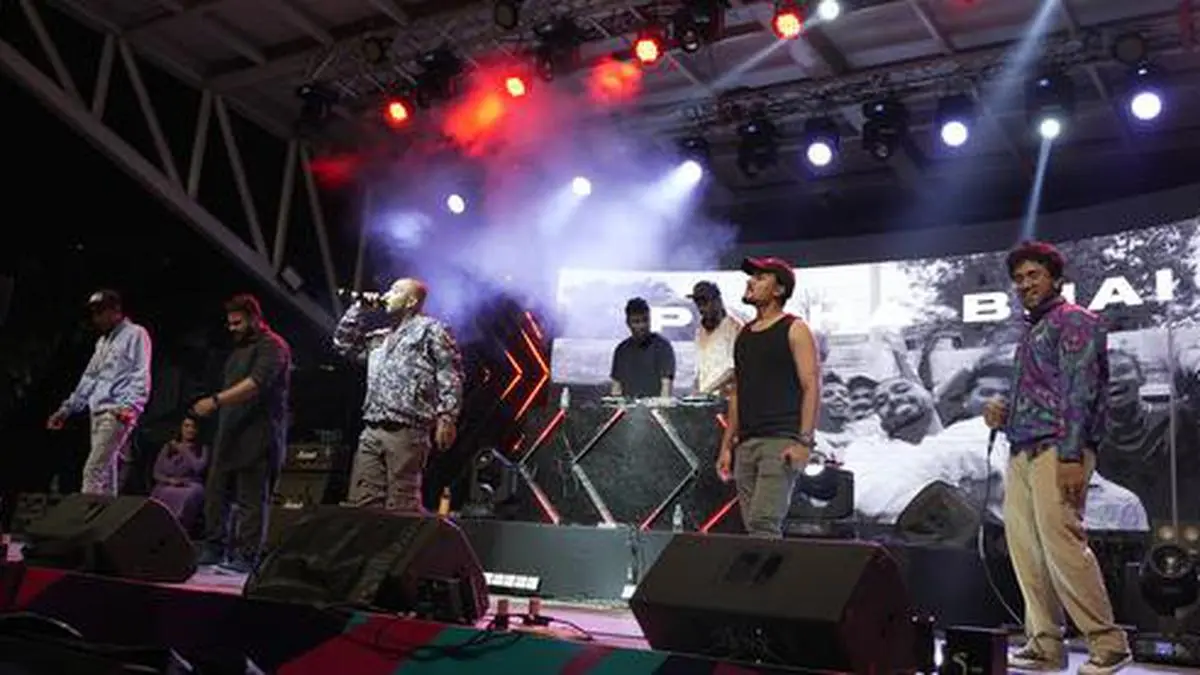
Pasha Bhai and members of Clan Bokka Phod performing at Bowring Club on May 7.
Bowring Institute, one of Bengaluru’s oldest social clubs, is pulsing with energy. Raftaar, a sensation in the Hindi and Punjabi rap scene, is the marquee act. Warming up the audience before he comes on is a bunch of Bengaluru-based rappers with funky monikers such as MC Truth, Ray, and Quake. Third in line is Pasha Bhai and his Clan Bokka Phod (CBP). On the evening of May 7, Bowring
When his turn comes, Pasha Bhai bounds onto the stage with his trademark energy. His hair cropped short and wearing a loose, full-sleeved T-shirt with baggy trousers that hang low on his waist, he opens with ‘Eid ka Chand’ (The Moon of Eid), one of his popular songs. A rousing cheer goes up from the audience, which is familiar with this number that has garnered more than 45,000 views on YouTube.
When Pasha Bhai sings the lines: “ ” (I’m my father’s spoilt brat/ My heart is like wax, but I have the courage of steel), some of his fans hum along. Pasha raps in street-Dakhni, and he raps at warp speed, which means that many in the crowd cannot grasp the lyrics but they are bound up in the frenzied covenant between singer and audience, which is part of the frantic mood of a rap concert. Even his band’s name is a Dakhni phrase for ‘ball-breakers’. Ladila Bawa Ka, Bigda Huwa Beta/ Moum Ka Dil, Par Jigra Loha Mera
Pasha follows up the first song with a few more popular solo numbers such as ‘Haraanya’n’ and ‘Kumbhakarana’. Then he is joined by his gang, the infamous Ball-Breakers, and they rap to ‘Khuda Gawah’.
Pasha screams ‘I love you Bangalore!’ before getting off the stage after his set. T-shirt soaked in sweat, he chugs down a bottle of water as fans walk up to him to take selfies. While the 23-year-old rapper has performed in several spaces in Bengaluru, being part of the opening act for Raftaar has added to the growing reputation of this savvy singer. There are some distinct reasons for Pasha Bhai’s success. First, his originality as a lyricist and his intuitive ability to vocalise in Dakhni; second, his moorings in a marginalised social and economic Muslim stratum in Bengaluru that resonates with the ethos of the early Black rappers who emerged from the ghettos of American cities; and third, his conscious use of Dakhni, his mother tongue, which some linguistic scholars argue is a language on its own but which is often dismissed as a dialect of Urdu.
Spoken mainly by Muslims in Karnataka, Telangana, Andhra Pradesh and parts of Tamil Nadu, Dakhni, translated as ‘Deccani’, traces its provenance to the reigns of the Bahmani and Deccan Sultanates between the 14th and 17th centuries whose territories sprawled across the Deccan plateau from the Arabian Sea to the Bay of Bengal. In certain parts of Hyderabad and Bengaluru and across urban centres in south India (except Kerala), Dakhni continues to be the lingua franca of a wide section of the non-Muslim population as well.
Says Bengaluru-based Arjun Sharma a.k.a Quake, the rapper who curated the event: “Pasha Bhai is one of the best thinkers/ writers out there. He’s talking sense and he’s talking reality. People should start understanding Dakhni to listen to him; that’s the only way our language will grow and get recognition. He is the only person representing Dakhni now.”
Pasha Bhai, whose non-rapping name is Mohammed Affan Pasha, has a simple studio, christened ‘Dakhnistan’, on the fourth floor of a nondescript building in the largely Muslim ghetto of Neelasandra in central Bengaluru. To get there, one has to negotiate a maze of narrow, meandering roads dotted with meat stalls, tiny mosques, and food kiosks. Minimally furnished, the most interesting thing in the dingy hangout is a carrom board around which Syed, Demixx, Nimbu Da, Marwan, Shoaib and Maddy of the CBP gang has gathered.
Pasha was born in 1998 and grew up in Neelasandra. “We are the children of rowdies,” he said, referring not to his father, who was an auto-driver and passed away when Pasha was still in school, but to the grimy milieu of violence that engulfed him and his clan members growing up in Neelasandra. Pasha always had an ear for music and as a high schooler he began to listen to American and Indian rappers such as Eminem, 50 Cent, Yo Yo Honey Singh, Raftaar, IKKA and Machas with Attitude.
The Hindi rappers were a tremendous influence on him. Among his greatest inspirations was Mumbai’s Naezy because he “is also a Muslim from the ghettoes of Mumbai”. Pasha began rapping in Hindi at the same time, and the 2019 film about a rapper also had an impact on his nascent career. At this time, Pasha was doing “chhatri kaaman” (petty jobs) for easy money. Having failed in Class 12 and with a floundering love affair to boot, Pasha began working in a garment factory as a helper. His mother worked there too. It took a year of hard work before he realised the importance of education and enrolled himself in evening college. Gully Boy
Amid this tumult, Pasha’s cachet as a rapper was soaring, as he continued to rap in Hindi and began fledgling attempts at rapping in Dakhni. For Pasha, the hip hop and rap culture was alluring because the genre “does not ask you to be anyone but to be real and true to yourself”. Pasha adds that there were “no restrictions while rapping and there is no structure to the music”. Connoisseurs of rap will disagree with this assessment, but Pasha’s confidence only reiterates the intuitiveness with which he has grasped the technicalities of the medium. Pasha says rap gave him the freedom to become a musician without learning music.
He also started a cypher (a gathering of rappers making music extemporaneously) called ‘Wanandaf’ (a shortening of ‘one and a half’) in 2019, the name inspired by the refrain of Bengaluru auto-drivers demanding an inflated fare. Held weekly in open spaces such as Cubbon Park and Lalbagh, Wanandaf attracted budding rappers, hip hop artists, beat boxers and graffiti artists before the pandemic stepped in. Part of why Pasha began Wanandaf was to democratise hip hop in India.
“Hip hop is owned by marginalised African Americans, but when it came to India it was acquired by the elite. It was a closed group of artists and I couldn’t enter its exclusive space. When we’d go to rap concerts wearing slippers, we weren’t allowed in. It made me hate the culture of rap music,” Pasha said. But by 2019, Pasha had surmounted these class barriers and become a respected member of a network of fellow rappers who appreciated him for his ingenuity, which led to creative collaborations and caught the attention of aficionados. Counting singles and collaborations, Pasha has made almost 30 songs so far. He was also a sought-after act during the anti-CAA (Citizenship [Amendment] Act) protests in Bengaluru.
Pasha is India’s first rapper in Dakhni, and this was not accidental. When he “did not find a representation of his language in the rap industry”, he consciously chose to rap in Dakhni and the exercise has turned into a quest to know more about his mother tongue. “As a child I would proudly speak Dakhni even though it was mocked and patronisingly referred to as ‘Broken Urdu’. I was ignorant that the dialect had a name, unaware of its origins, history or associations. Like others around me, I grew up calling it ‘Bangalori Urdu’. As I researched further, I realised that Dakhni has always been under threat of being erased, misnamed or compelled to become a ‘dialect’ of a larger language and cultural group. The legacy of Dakhni poets and artists has been one fraught with constant struggle to keep Dakhni-ness alive.”
Hyderabad-based journalist and researcher Yunus Lasania argues that it is wrong to describe Dakhni as ‘Urdu’ or ‘Hyderabad Hindi’. “Dakhni (or Deccani) is usually mistaken to be a ‘dialect’ of Urdu, especially among northern Urdu speakers. Both Dakhni and Urdu have roots in Dehalvi (also known as ‘Old Urdu’), which existed in Delhi for around a century before it reached the Deccan in the 14th century through the conquests of Mohammed Tughlaq. Dakhni is a mix of Persian, Old Urdu (Dehalvi), Kannada, Marathi and Telugu. It was created when Dehalvi mixed with the three aforementioned languages,” he said.
Karthik Malli, an independent researcher and writer working on south Indian language histories, said, “Dakhni has, in all likeliness, been part of Bengaluru’s social landscape for many centuries now. Numerous Sufi shrines in Chickpet dating back to the 1700s catered to local Dakhni-speaking Muslims. Tipu Sultan [who was born in Devanahalli on the outskirts of modern Bengaluru] was a Dakhni speaker as well, and even commissioned literary works in the Classical Dakhni register cultivated earlier in Bijapur and Golkonda.”
Malli added, “Despite Dakhni’s presence and history in the city, it has seldom found any serious artistic expression. Digital media is helping change that by giving voice to artists like actor and comedian Danish Sait who utilises Dakhni to great effect in his highly popular comedic skits. Sarah Fazal, an RJ, also makes Dakhni skits on Instagram. There are also a number of social media meme pages that utilise Bangalore Dakhni, directly addressing a large local audience that uses the language in everyday life.” Pasha’s name must be added to this short list as someone who is furthering Dakhni in popular culture through rap.
India Foundation for the Arts (IFA) has awarded Pasha a grant for his project titled “ ”, which seeks to “keep Dakhni language and culture alive through the art practice of rap and hip hop”. Said Sumana Chandrashekar of IFA, “With the privileging of certain cultures to the exclusion of many others, there is always the danger of losing sight of the rich multi-textured nature of experiences, narratives, people and languages that collectively form the fabric of this city. From this point of view, IFA is delighted to implement a project with Pasha to explore and engage with Dakhni expressions in Bengaluru’s popular culture. What is special about this project is that it embraces and embodies Pasha’s deeply personal lived experiences with Dakhni and moves on to excavate the deep cultural bond that this language has with the city. For us, the project is not just a celebration of Dakhni as a language but also a reaffirmation of the many cultures, histories and languages that make our city ” Apnich Bol, Dakhnich Bolnamma Bengaluru.
With his rising popularity and the support of respectable patrons such as IFA, Pasha has made the leap from Neelasandra to exclusive music spaces in the city. Looking at his talent and verve, his journey so far seems like the first chapter of a long book. This cocky segment in the collaborative rap piece ‘56’ illustrates his persona and talent more clearly:Pasha bhi aako hin dekho sabbi jane khamush rhao,Gunna ginne scene ni scene huit’ long uthao,Tada dek’ tadpatin kisse to b uska taaluk rhaoChillar’an ku baazu b ni rakhte, chalo baazuk’ jao.
(Pasha bhai has arrived, everybody pipe down!
A scene breaking out, brandish your swords, strictly
no guns
You’re going to get it good – doesn’t matter who you
know,
Now move, you’re loose change, not worth my time,
now go!)
—Translated by Sahar Adil
Street smart
First rapper in Dakhni
source: http://www.frontline.thehindu.com / The Hindu / Home> Lead Story> Cover Story : Pasha Bhai / by Vikhar Ahmed Sayeed / May 17th, 2022
Prof. Abdul Qavi Desnavi (November 1, 1930 – July 7, 2011)
Bhopal:
A two-day National seminar is being organised on “Prof. Abdul Qavi Desnavi Hyat Aur Adabi Khidmat” here on April 1 and 2 at Mulla Ramuzi Sanskriti Bhavan, the headquarters of Madhya Pradesh Urdu Academy, (MPUA).
The seminar is being organised by Ilma Education Society, Bhopal under the joint aegis of National Council for the Promotion of Urdu Language, (NCPUL) and MPUA.
Mr. Kailash Sarang, former Rajya Sabha member, will inaugurate the seminar on April 1 at 10 am which will be presided over by Urdu litterateur Prof. Afaq Ahmad.
AThe guests of honour on the occasion include: Mr. Aziz Qureshi, ex-member of Lok Sabha, Mr. Iqbal Majeed, Prof. Shakoor Khan, Prof. Muzaffar Hanafi and Prof. Ateequllah.
Prof. Afaq Husain Siddiqui will deliver the keynote address in the inaugural function while Kausar Siddiqui, director of the organising committee shall welcome the guests. Mr. Ali Mutaqqui Desnavi, the eldest son of late Prof. Abdul Qavi Desnavi will propose vote of thanks.
After the inaugural function there would be two sessions on April 1 and three on the next day. Two-and-a-half dozen scholars and writers from all over India will present their papers in different sessions of the seminar.
They include: Prof. Muzaffar Hanafi (Delhi), Mr. Ayub Waqif (Mumbai), Master Akhtar, Mr. Arif Aziz & Dr. Arjumand Bano Afshan (all three from Bhopal), Prof. Ateequllah (Delhi), Prof. Khalid Mahmood (Delhi), Maulana Syed Sharafat Ali Nadwi (Bhopal), Dr. Yaqoob Yawar (Banaras), Mr. Iqbal Masood, Mr. Rasheed Anjum & Dr. (Mrs.) Razia Hamid (all three from Bhopal), Dr. Saifi Sironji (Sironj), Prof. Manzar Husain (Ranchi), Prof. Afaq Ahmad (Bhopal), Dr. Maula Baqsh (Delhi), Mr. Naseem Ansari (Bhopal), Mr. Zia Farooqui, Mr. Ashfaq Mashhadi, Mr. Khalid Abidi, Dr. Mahtab Alam & Mr. Javed Yazdani (all six from Bhopal), Dr. Mohammad Nauman & Dr. Khalid Mubashshir (both from Delhi), Dr. Abdul Waheed Khan (Jabalpur), Mr. Naeem Kausar, Mr. Khursheed Akhtar (both from Bhopal), Dr. Shan Fakhri (Sironj), Mr. Habib Ahmad & Mr. Inamullah Lodhi (both from Bhopal).
Meanwhile, it may be stated here that Prof. Abdul Qavi Desnavi (November 1, 1930 – July 7, 2011) was an Indian eminent Writer, Critic, Bibliographist, Linguist and Scholar of Urdu language. He has authored more than 50 books on Urdu literature. His books were also translated in other languages. His important work was about Maulana Abul Kalam Azad, Mirza Ghalib, Allama Muhammad Iqbal and litterateurs of Bhopal.
He was recipient of several awards. He received Senior Fellowship from the Union Ministry of Culture, Govt. of India. His great treatise was a voluminous book on one of India’s frontline freedom fighter and first Union Education Minister Maulana Abul Kalam Azad over 900 pages titled “Hayat-e-Abul Kalam Azad” which he penned in the year 2000. It was acclaimed nationally and internationally.
Desnavi was born in Nalanda Prof. Desnavi was born on November 1, 1930 in village Desna of block Asthawan in Nalanda district Bihar. He belonged to the family of Great Muslim scholar Syed Sulaiman Nadvi, who was one of the eminent historian and biographers of the Islamic Prophet Muhammad (PBUH), during his times. He was the second son of late Prof. S. M. Saeed Raza, who was Professor of Urdu, Arabic and Persian languages in St. Xavier’s College, Mumbai. His elder brother was Prof. Syed Mohi Raza and younger brother was Syed Abdul Wali Desnavi.
Education Prof. Desnavi had his primary education in Arrah town of Bihar state. After completing his graduation & post-graduation in First Division from St. Xavier’s College, Mumbai, he joined Department of Urdu in Saifia Post Graduate College, Bhopal in February 1961. He went on to become Professor and Head of the Urdu Department of Saifia Post Graduate College. He was well-known literary figure in India and in the Urdu world.
His shining disciples Many scholars, poets and teachers of today such as lyricist Javed Akhtar, Poet Mushtaq Singh, Prof. Muzaffar Hanafi, Selani Silwatte, Prof. Khalid Mehmood, Prof. Mohammed Naumaan Khan, Prof. Afaq Husain Siddiqui, poet Iqbal Masood, Dr. Iqbal Masood Nadvi, Ahsanuddin Farooqui, Khurshid Akhtar, Mohammed Naseem, Dr. Qamar Ali Shah, Prof. Yaqoob Yawar, Maulana Syed Sharafat Ali Nadvi, Prof. Arjumand Bano Afshan etc. were under his tutelage during their student days in Bhopal and are now sparkling in the Urdu world. Under his guidance many students attained Ph.D. degrees.
He retired in 1990. He was also holding many Honorary positions such as: • Additional Principal of Saifia Post Graduate College, Bhopal.(1983–1985); • Secretary of Madhya Pradesh Urdu Academy, Bhopal (1991–92); • Elected Member Majlis-e-Aam Anjuman Taraqqui Urdu (Hind), New Delhi (1979–1984); • Member of All India Anjuman Taraqui Urdu Board, New Delhi, (1977–1978); • Member of Program Advisory Committee, All India Radio, Bhopal (1978–1979); • Member Executive Council, Barkatullah University Bhopal, (1980–1982); • Chairman of Board of Studies, Urdu, Persian & Arabic, Barkatullah University Bhopal, (1977–1980) and (1984–1985); • Dean Faculty of Arts, Barkatullah University Bhopal, (1980–1982) & • Member Working Committee, Taj-ul-Masajid, Bhopal (1997-2007)
Awards Prof. Desnavi received many awards in his lifetime such as Shibli Award, Mumbai, 1957; Senior Fellowship, Ministry of Education & Culture, Government Of India for 4 Years, 1979-1983; Sanad “Imteyaz Meer” All India Meer Academy, Lucknow 1981; Nawab Siddique Hasan Khan Provincial Award, Bhopal 1986; Bihar Urdu Academy Award, for recognition of Urdu services (1988–89) & (1989–90); All India “Parvez Shahidi Award” West Bengal Urdu Academy, Calcutta 1998.
His books The books Prof. Desnavi authored to enrich the Urdu literary world included: Ek Aur Mashriqi Kutub Khana (1954); Hasrat Ki Siyasi Zindagi (1956); Aur Hindustan Jag Utha (1963); Allama Iqbal Bhopal Mein (1967); Mazameen Lisan-un-Sidque (1967); Bhopal Aur Ghalib (1969); Ghalibyaat (1969); Nuskha-e-Bhopal Aur Nuskha-e-Bhopal Sani (1970); Qadir Nama-e—Ghalib (1971); Anis Numa (1973); Ek Shahar Panch Mushahir (1973); Nazr—e-Sajjad (1974); Mota’ala—e—Khotoot—e—Ghalib 1975, (Edition 2nd 1979); Saat TahrireiN (1975); Hindustan MeiN Iqbaliat (1976); Talash-o—Taasur (1977); Mehdi Hassan Efadi (1977); Iqbal Uneesween Sadi MeiN(1977); Mirza Salaamat Ali Dabeer (1977); Bachon Ka Iqbal (1978); Iqbal Aur Dilli (1978); Abdul Haque Banam Mahvi (1980); Nazr-e-Takhallus (1981); Mota’ala-e-Ghobar-e—Khatir (1981); Dhanpat Rai Nawab Rai Premchand (1981); Iqbal Aur Darul Iqbal Bhopal (1983); Iqbaliat Ki Talash (1984); Yadgar—e—Sulaiman (1984); Iqbaliat Ki Talash Publisher, Globe Publishers, Urdu Bazar Lahore, Pakistan (1985); Armoghane-Saifia (Co—Editor) (1986); Abul Kalam Azad (1987); Maulana Abul Kalam Mohiuddin Ahmad Azad Dehlavi (1988); Mahanama Lisan-un-Sidque (1988); Yadgar—e—Azad (1989); Mataihiyat (1989); Talash—e—Azad; Talash-e-Azad, Shaqsiyat, Khidmat, Chand JhalkiaN (1990); Jawaharlal—o—Azad (Co—Editor) (1990); Ajnabi Shahar (1992); Fakhernama (Co—Editor) (1997); Urdu Shairi Ki Gayarah AwazaiN; Masreen wa Mutaliqat Azad; Hayat Abul Kalam Azad (2000); Bombai Se Bhopal Tak (2004); Dur Dais Se (2005); MaiN Urdu Hoon (2006).
His books translated in other languages are: Abul Kalam Azad in Hindi language Translated by Janki Prashad Sharma, Publisher Sahitya Akademi (1987); Abul Kalam Azad in Punjabi language Translated Inder Singh Raz Publisher Sahitya Akademi (1988); Abul Kalam Azad in English language translated by Syeda Syedain Hamid Publisher Sahitya Akademi(1991); Abul Kalam Azad in Maithili language translated by Fazlur Rehman Hashmi, Publisher Sahitya Akademi (1994)
The awards Prof. Desnavi received on his books are: Saat TahrireiN – Uttar Pradesh Urdu Academy Lucknow, 1975; Uneesween Sadi Mein Iqbal – Bihar Urdu Academy Patna, 1977; Mota’ala-e-Khotoot Ghalib – Bihar Urdu Academy Patna, 1979; Mota’ala-e-Ghobar-e-Khatir – Bihar Urdu Academy Patna, 1981; Iqbaliat Ki Talash – Bihar Urdu Academy Patna, 1984, Abul Kalam Azad Academy, Bihar Urdu Academy Patna, 1987; Yadgar—e—Sulaiman – Maghribi Bengal Urdu Academy Calcutta, 1984; Talash—e—Azad – Uttar Pradesh Urdu Academy Lucknow, 1991; Talash—e—Azad – Bihar Urdu Academy Patna, 1991; Talash—e—Azad – West Bengal Urdu Academy Calcutta, 1993; Urdu Shairi Ki Gayarah AwazaiN – Uttar Pradesh Urdu Academy, Lucknow, 1993; & Urdu Shairi Ki Gayarah AwazaiN – Bihar Urdu Academy, Patna, 1993.
Under his guidance the Ph.D. degrees were awarded by Barkatullah University to • Dr. Muzaffar Hanafi – “Shad Arfi Shaksiat Aur Fun” 1974 Published – 1977; • Dr. Hadiqa Begum – “Abdul Rehman Bijnori Hayat Aur Khidmat” 1981 Published – 1984; • Dr. Naseem Shanvi- “Urdu Tanquid Ka Marxi Dabistan” 1981; • Dr. Mohammed Ayub Khan – “Iqbal Aur Gazal Goi” 1982; • Dr. Safia Wadood – “Takhalus Bhopali Hayat Aur Khidmat” 1984 Published – 1993; • Dr. Arjumand Bano – “Riasat Bhopal Aur Mushahir Urdu” 1989; • Dr. Shan Ahmed Fakhri – “Sironj Ki Khidmat” 1990 Published – 1999; • Dr. Yaqoob Ali Khan – “Taraqqui Pasand Shairi Aik Jaiza” 1990 Published – 1997 and • Dr. Mohammed Naumaan Khan – “Bhopal MeiN Urdu Inzamam Ke Baid”1990.
Poems The poems composed on Prof. Desnavi include: • Pasban-e-Urdu by Rahbar Jaunpuri; • Nazre Abdul Qavi Desnavi by Arshad Siddiqui; • Anjuman Ilm-O-Kamal by Zafar Sahbai; • Herf-e-Khuloos by Kausar Siddiqui; • Shan-e-Imtiaz by Zafar Naseemi; • Qandil-e-Hikmat, Abdul Qavi Desnavi by Wafa Siddiqui;
• Kharaj-e-Tehsin by Arman Akberabadi; • Pahchaan Hai Saifia by Kamil Baihzadi; • Prof. Abdul Qavi Desnavi by Mateen Qurashi Shaheed and • Aik Nazem by Iqbal Masood.
Last breath Prof. Desnavi died at about 5 am on 7 July 2011 in a private hospital where he was admitted following complaints of old age related diseases. He is survived by his wife, three sons and four daughters and a large number of relatives and literary friends to mourn his loss.
(pervezbari@eth.net)
source: http://www.twocircles.net / TwoCircles.net / Home> Indian Muslim> Literature / by Pervez Bari, TwoCircles.net / March 30th, 2012
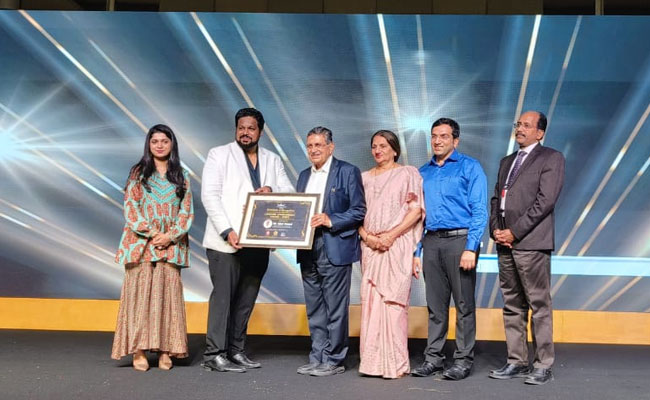
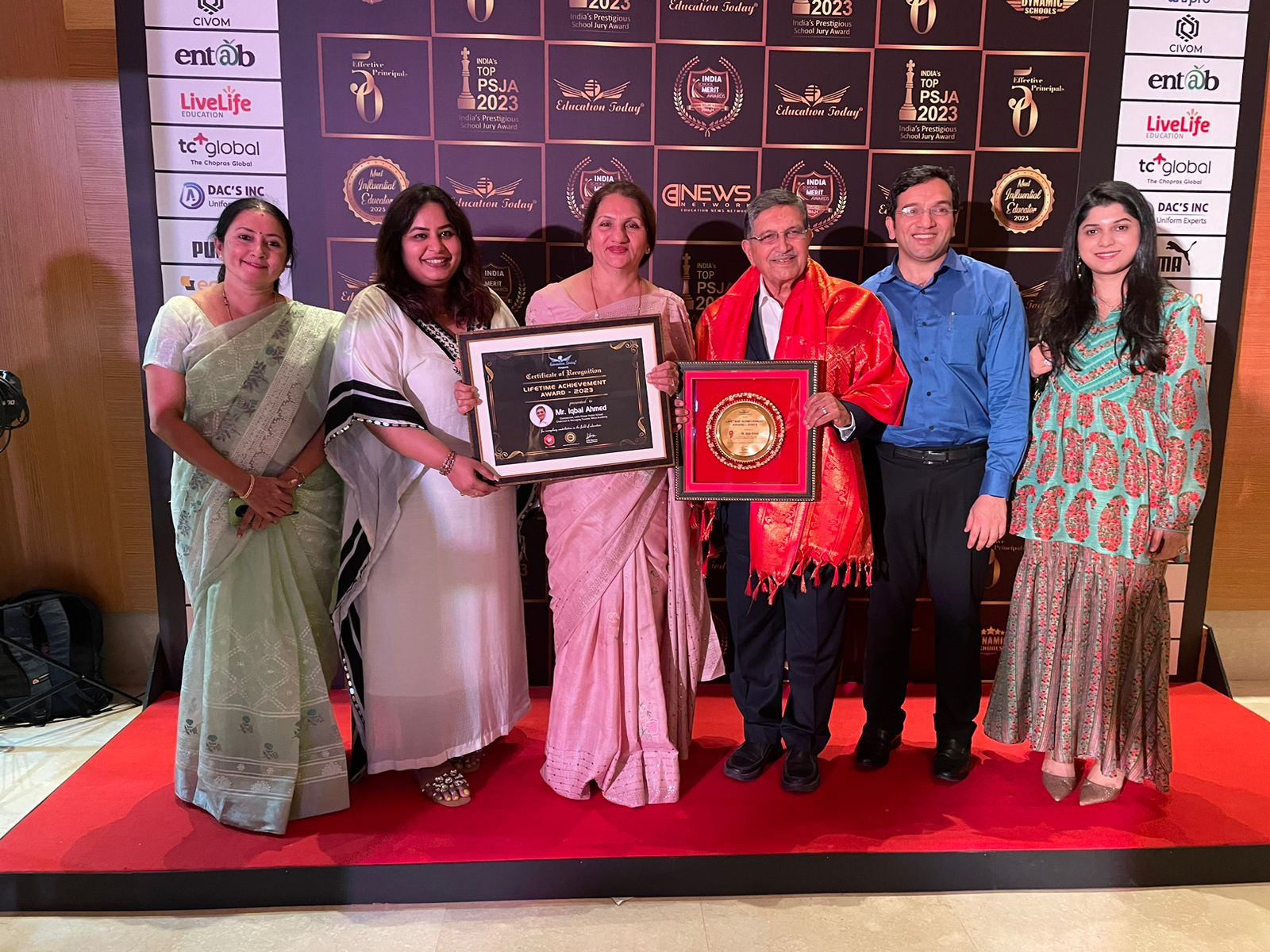
In recognition of his outstanding contributions to the field of education, Iqbal Ahmed, Chairperson of Little Flower Public School and Chairman of Mitra Academy in Bengaluru, was bestowed with the prestigious Lifetime Achievement Award – 2023 by Education Today Magazine.
The ceremony, held at the Taj Hotel Kempegowda International Airport Rd, Bengaluru, on December 11, 2023, celebrated Ahmed’s commitment to educational excellence.
“The accolade is a testament to Mr. Ahmed’s deep-rooted passion for education, driven by a sense of social responsibility. His leadership has not only elevated academic standards within the schools but has also prioritized holistic development, shaping students into well-rounded individuals with both knowledge and character. His dedication to excellence serves as an inspiration to educators and learners alike,” a press release stated.
The Lifetime Achievement Award recognizes Iqbal Ahmed’s impact on the educational landscape, acknowledging his role in providing exceptional education at an accessible cost.
Expressing gratitude upon receiving the award, Iqbal Ahmed attributed the honour to the collective efforts of the school’s faculty, staff, students, and parents.
In addition to Iqbal Ahmed’s Lifetime Achievement Award, the ceremony also celebrated Tanveer Ahmed, CEO of Mitra Academy and Little Flower Public School, and his wife, Nafeesa Ahmed, Director of Presidency Group of Institutions Bengaluru/Mangaluru, who were honoured with the Power Couple Award for 2023 by Education Today Magazine.
source: http://www.english.varthabharati.in / Vartha Bharati / Home> India / by Vartha Bharati / December 12th, 2023
In the bustling city of Bangalore, where the convergence of tradition and modernity creates a unique educational landscape, Dr Nafeesa Ahmed stands as a beacon of transformative leadership in the field of education. Dr Nafeesa has carved out a unique path for herself as the Director of the Presidency Group of Institutions while also carrying on her father, Dr Nissar Ahmed’s legacy of excellence and innovation.
Dr Nafeesa Ahmed, Director, Presidency Group of Institutions, Bengaluru, Karnataka
Dr Nafeesa’s educational journey is nothing short of impressive. A graduate of Mount Carmel College, Bangalore, she holds a Bachelor of Business Management (BBM) degree and pursued postgraduate studies in English literature at Bangalore University. Her commitment to education led her to earn a bachelor’s degree in education from IGNOU. Venturing beyond Indian shores, Dr Nafeesa enriched her perspective with a Master’s in International Management from Royal Holloway, University of London. This international exposure was instrumental in shaping her understanding of global education trends.
Her dedication to continuous learning took her to the prestigious Harvard School, where she honed her skills in management and leadership. Dr Nafeesa’s academic prowess is underscored by her diverse qualifications, including a BBM, a B.Ed., an MA in English Literature, and a Master’s in International Management. Her educational journey serves as an inspiration, reflecting the importance of a broad and holistic approach to learning.
Leadership at the Presidency Group of Institutions
Taking the reins as the Director of the Presidency Group of Institutions, Dr Nafeesa has led the K-12 chain of elite institutions with a commitment to “Equal Opportunity in Diversity.” Her vision is to provide high-quality, affordable education to students from diverse backgrounds. Focusing on aspects like course structure, pedagogical innovation, and outcome-based evaluation, she has fostered a conducive teaching and learning environment.
During the challenging times of the pandemic, Dr Nafeesa displayed exemplary leadership by seamlessly transitioning the education system from physical to virtual and eventually to a mixed classroom approach. Her leadership has been pivotal in ensuring that the team of highly-qualified educators delivers the finest education to students.
Accolades and Achievements: A Trailblazer in Education
Dr Nafeesa’s journey is adorned with prestigious awards and recognitions, attesting to her significant contributions to the field of education. Notably, she received the Economic Times Power Icon Award for “Exceptional Contribution in Education” in 2020 and was honoured as “The Education Icon of the Year 2021” by Education Today. Her recognition as a ‘Speaker’ at the “APAC 5th Global Education & Skill Conclave” and features in Women Entrepreneurs and Education World India showcase her as a thought leader in the education domain.
A crowning achievement in her illustrious career is the conferral of a Ph.D., Philosophiae Doctor Honoris Causa (HC) in Education Management by Ecole Superieure Robert De Sorbon (ESRDS), France, Europe. The recognition, awarded at The House of Lords, London, is a testament to Dr Nafeesa’s global impact and commitment to educational excellence.
As Dr Nafeesa Ahmed continues to shape the future of education, her journey stands as an inspiration, showcasing the transformative power of visionary leadership in the realm of academia. In the words of Dr Nafeesa, “My loved ones have been my rock through thick and thin. Having their back has been crucial to my success.” Indeed, her success radiates not only through personal accolades but also through the positive impact she has had on the lives of countless students and educators.
source: http://www.outlookindia.com / Outlook / Home> Brand Studio / by The Outlook Bureau / March 08th, 2024
Seven students of MS Junior College scored above 99 percentile in JEE mains result 2025.
Among the students, Munazza Siddiqui scored 99.016 percentile in the exam.
The result of JEE mains 2025 was declared nationwide on Saturday, April 20 by the NTA.
Alongside Munazza, several other students from MS Junior College also showcased excellent performance in JEE Main 2025.
List of 7 MS students who scored above 99 percentile in IIT-JEE mains result 2025
A total of 7 students scored above the impressive 99 percentile. They are as follows:
Hafiz Mohammed Abdul Muheeth Simal – 99.86 percentile
Mohammed Ridhan – 99.74 percentile
Muhammed Zahi Faisal – 99.57 percentile
Hamza Wesal – 99.42 percentile
Afnan Ahmed – 99.30 percentile
Adnan Fayas NK – 99.08 percentile
Munazza Siddiqui – 99.016 percentile
In addition, 21 students scored above 93.10 percentile. The total number of MS students qualifying for the prestigious JEE Advanced is 37.
Toppers were felicitated
To celebrate the achievement, Munazza Siddiqui and other top-performing students were felicitated at a special ceremony held at the MS Education Academy’s Corporate Office, Masab Tank, Hyderabad.
On the occasion, the Founder and Chairman of MS Education Academy Mohammed Lateef Khan described Munazza’s success as “historic,” calling it a guiding light for girls of the entire community. He also extended congratulations to all the successful students, their parents and teachers.
The event was also graced by MS Education Academy’s Managing Directors Anwar Ahmed and Dr. Moazzam Hussain.
So far, 173 students from MS have secured admission into IITs, NITs, and other top national institutions.
source: http://www.siasat.com / The Siasat Daily / Home> Lifestyle / by Sameer Khan / April 20th, 2025
The Presidency Group of Institutions (PGI) hosted INSPIR’Ed Awards 2025 on Saturday on the Presidency University campus. The event honoured teaching and non-teaching staff for their contributions to education and service within the Presidency Institutions.
Author Anita Nair and former IPS officer and cybersecurity expert Sanjay Sahay were chief guests at the event. They emphasised the significant role educators play in national development.
Nafeesa Ahmed, Director of the Presidency Group of Institutions, spoke about the central role of teachers in guiding students and strengthening communities.
Kauser Nissar Ahmed, Founder Trustee, expressed appreciation for everyone involved in the growth of the Presidency Schools. Dr. Nissar Ahmed, Chairman of PGI and Founder Chancellor of Presidency University, reflected on his five-decade journey in the field of education.
Awards were presented in several categories, including: Long Service Award, Institutional Legacy Award, Best Teacher Award, Rising Star Award.
source: http://www.thehindu.com / The Hindu / Home> News> Cities> Bengaluru / by The Hindu Bureau / April 14th, 2025
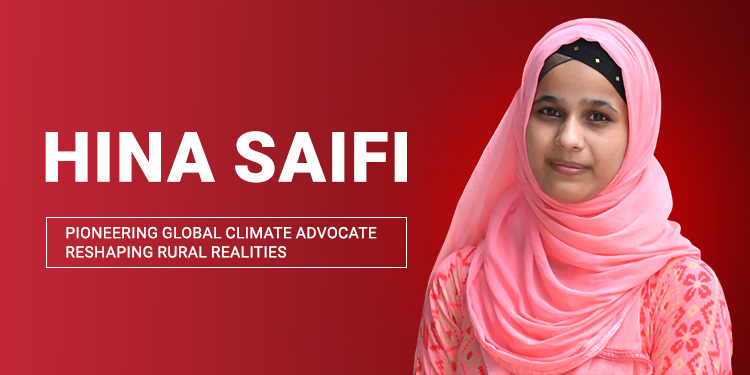
Hina Saifi’s remarkable journey from rural roots to Climate Change Champion is an inspiring example of empowering change.
Hina Saifi pioneering Global Change Advocate reshaping rural realities
A youthful dreamer and a climate change activist named Hina Saifi has lit the route to long-term reform in the heart of Uttar Pradesh. She was born and reared in Sisola, a humble village in Meerut district. Her journey from a low-income family to a trailblazing advocate for climate education and action exemplifies the spirit of leadership that crosses borders. Hina Saifi’s United Nations association in the campaign known as #WeTheChangeNOW led her to be part and face of the campaign among the list of 17 climate change leaders.
Early Life and Education
Hina Saifi, Meerut’s resident, hails from Sisola, where education for girls is a formidable challenge.
Hina, the young climate leader, is currently pursuing MBA from the Bharti Institute of Technology, Meerut. She has reached this stage in life with her true dedication and willingness to break the stereotypical barriers of her village and change the existing mindsets.
Considering the situation of Sisola, an underdeveloped village in Uttar Pradesh, Hina couldn’t even imagine pursuing her studies post-8th grade, over a decade ago.
Managing to achieve complete school education, along with higher studies, Hina has showcased her limitless power and outshined on a national level for Women Climate Crusaders among 16 other women.
Hina Saifi, Women Climate Collective’s crucial member, has made a remarkable turn in her life. Her trajectory seemed predestined by the harsh realities of her village, where education was a luxury and the pursuit of higher learning was rare.
However, against all odds, Hina’s mother recognized the value of education and facilitated her journey to knowledge.
At such a young age, her thoughts align with personal as well as environmental growth and sustainability, which sets her apart from today’s youth.
“Poverty is rampant in my underdeveloped village, and child labor is common here. I, too, was advised to stop studying after I finished the eighth standard. However, I stuck to my decision to study further. To support myself through school and to help my family, I also worked part-time in a football factory”.
—– Hina Saifi
Hina Saifi: Championing Climate Education
22-year-old Hina Saifi’s journey into climate advocacy began with a realization that education was the cornerstone of addressing the multifaceted challenges troubling her village.
Armed with this insight, she set out on a quest to motivate children to attend school, thereby causing a small wave of awareness.
Partnering with local NGOs and the ‘Women Climate Collective’ (WCC), she found her voice in discussions about climate change, clean energy, and sustainability.
She was the first one from her village to move to Lucknow and be part of the Climate Agenda Initiative 2018.
Proud to be a member of Women Climate Collective, she supports the notion that addressing the climate crisis and fighting climate change is a collective responsibility of the people and not just that of the government alone.
Hina has also achieved an international recognition by her association with #WetheChangeNOW campaign by United Nations(UN) in India. The campaign showcases the climate based solutions devised by 17 young Indians that are innovative, sustainable and equitable, further focusing on strengthening engagements with governments and society.
The Hina Saifi Chronicles of Grassroots Change
Hina’s endeavors extended beyond education, culminating in the ‘Suraj Se Samriddhi’ campaign, launched by herself that spotlights solar power’s potential and advocates for cleaner energy solutions.
Her grassroots approach, encompassing workshops, speeches, and dialogues, has led to tangible change: cleaner streets, waste-free water bodies, and enhanced greenery. She acknowledges the intrinsic link between education and climate, recognizing their mutual capacity for transformation.
Hina’s belief in micro-behaviors as agents of monumental transformation underscores her leadership philosophy. By engaging with the village Pradhan and initiating innovative projects, she showcases the potential of individual actions to revolutionize communities.
Her involvement in the ‘100% Uttar Pradesh’ initiative reflects her dedication to the larger cause, emphasizing that collective progress stems from local commitment.
Hina Saifi: Empowering Change Through Climate Advocacy
Hina Saifi’s journey, stemming from her village’s challenges, inspires hope for a greener future. As a catalyst for change, her efforts stimulate broader dialogues concerning the representation of women’s voices in climate advocacy. Through platforms like the Women Climate Collective, her voice resonates beyond geographical boundaries, exemplifying the power of unity in tackling global challenges. From her humble origins in Sisola to her pivotal role within the Collective, Hina embodies the leadership needed for a brighter tomorrow. Her story showcases how determination and knowledge can bring about significant change.
source: http://www.leaderbiography.com / Leader Biography / Home> Featured> Featured Women / by Rahul Iyer